It’s the second
biggest volcano in Europe and Northern Africa, Italy’s colossus Mount Etna is
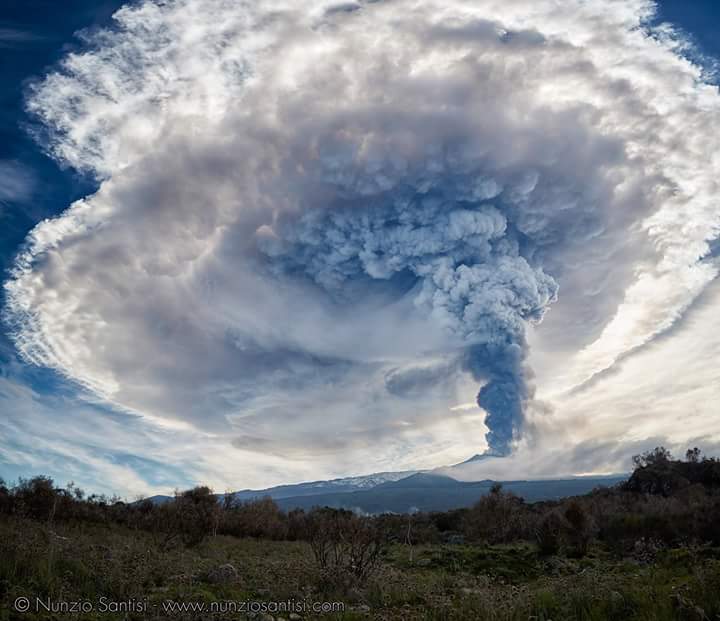
today showing activity captured by Skylinewebcams.
After a
week of freezing weather two large quakes and an avalanche killing people
trapped in a hotel, Italy’s colossus Mount Etna bursts into life.
Mount Etna
(or Etna; pronunciation: /ˈɛtnə/; Italian: Etna [ˈɛtna] or Mongibello [mondʒiˈbɛllo],
Sicilian: Mungibeddu [mʊndʒɪbˈbɛɖɖʊ] or â Muntagna, Latin: Aetna) is an active
stratovolcano on the east coast of Sicily, Italy, in the Metropolitan City of
Catania, between the cities of Messina and Catania.
It lies
above the convergent plate margin between the African Plate and the Eurasian
Plate. It is the tallest active volcano in Europe, currently 3,329 m (10,922 ft.)
high, though this varies with summit eruptions.
It is the
highest peak in Italy south of the Alps. Etna covers an area of 1,190 km2 (459 sq.
mi) with a basal circumference of 140 km. This makes it by far the largest of
the three active volcanoes in Italy, being about two and a half times the
height of the next largest, Mount Vesuvius. Only Mount Teide in Tenerife (owned
by Spain) surpasses it in the whole of the European–North-African region. In
Greek Mythology, the deadly monster Typhon was trapped under this mountain by
Zeus, the god of the sky and thunder and king of gods, and the forges of
Hephaestus were said to also be located underneath it.
Mount Etna
is one of the most active volcanoes in the world and is in an almost constant
state of activity. The fertile volcanic soils support extensive agriculture,
with vineyards and orchards spread across the lower slopes of the mountain and
the broad Plain of Catania to the south. Due to its history of recent activity
and nearby population, Mount Etna has been designated a Decade Volcano by the
United Nations. In June 2013, it was added to the list of UNESCO World Heritage
Sites.
Mount Etna had suffered a dramatic rupture after a "new cut-up" opened up alongside its energetic crater. Footage from the scene exhibits lava rocks flying into the air and orange streams oozing down Mount Etna's slopes. The brand new cut up within the crater seems to have bisected the well-known volcano. The risky volcano started erupting final Sunday, in keeping with an area volcanologist. Boris Behncke, from the INGV-Osservatorio Etneo in Catania, Sicily, stated that lava started "oozing" from the Etna's southeast crater and towards the east final weekend.
Etna, one of the world's most active volcanoes and the biggest in Europe, is threatening to cause a dangerous lava flow and possibly another earthquake, experts warned on Thursday as the region declared a state of emergency.
Etna erupted on Christmas Eve, spewing giant clouds of smoke and ash onto nearby cities, towns and vineyards in the busy coastal corridor of eastern Sicily.
The eruption was followed Wednesday by a 4.8 magnitude earthquake that caused extensive damage, cracking homes, churches and roads.
About 1,000 tremors were felt, La Stampa newspaper reported, and thousands of people were sleeping on the streets.
No deaths were reported.
About 600 people were declared homeless as a result of the damage.
Italy's two political leaders, Deputy Premier Luigi di Maio, the leader of the 5-Star Movement, and Deputy Premier Matteo Salvini, the leader of the League party, were expected to visit the hard-hit area Thursday.
The region of Sicily called a state of emergency.
There's a danger that Etna could erupt at a lower elevation, causing a lava flow threatening inhabited areas.
As of Thursday, the volcano appeared to be calming down.
Boris Behncke, a volcanologist at the Etna Observatory at Italy's National Institute of Geophysics and Volcanology, said on Wednesday night through his Facebook page that there was little left of Monday's lava eruption and that seismic activity was calming.
Still, there's always a lot of uncertainty about what is happening in the belly of this volcano.
Behncke said it was possible this eruption could become more active again and even for a lava flow to open up at a lower elevation.
About 1 million people live on the flanks or in the shadow of the volcano, many of them in Catania, Sicily's second-largest city.
Catania is an ancient city and many of its buildings are constructed from black lava stone.
It lies only about 18 miles from Etna's summit.
Etna is one of the most monitored volcanoes in the world, in no small part because of its potential dangers.
Scientists say the volcano is slowly being pulled into the Ionian Sea and this gradual movement likely will cause more eruptions and earthquakes, similar to those of this week.
The grimmest scenario is a catastrophic collapse of the volcano's southeast flank, but scientists say there is no evidence of that occurring any time soon.
Long exposure image of a "dual-vent" eruption from Mount Etna's NSEC (New South East Crater) Credit Wikipedia
Mt. Etna is sliding and Europe's most active volcano is prone to a devastating sector collapse on the downslope side of the mountain.
A British led team of scientists have established that the whole structure on the Italian island of Sicily is edging in the direction of the Mediterranean at a rate of 14mm per year, it doesn't sound very much but the strain on billions of tonnes of rock must cause incalculable stress and at some point in the future a spectacular collapse is inevitable.
Geological investigations elsewhere in the world have shown that extinct volcanoes that display this kind of trend can suffer catastrophic failures on their leading flank as they drift downslope.
Stresses can build up that lead eventually to devastating landslides.
To emphasize the problem, Mount Etna is Europe's most active volcano and is prone to seismic activity.
Certainly, there is absolutely no evidence that this is about to happen at Etna.
Local residents should not be alarmed, the Open University scientist said.
"The 14mm/yr is an average; it varies from year to year," he explained.
"The thing to watch I guess is if in 10 years' time the rate of movement has doubled - that would be a warning.
#etna #eruzione #vulcanoetna
Mount Etna, the famous Sicilian volcano, has erupted for the first time in more than a year.
The highest volcano in Europe burst into life on Monday evening and continued to produce fountains of bright orange lava into Tuesday. Mount Etnahas roared back into spectacular volcanic action, sending up plumes of ash and spewing lava.
Italy's National Institute of Geophysics and Vulcanology (INGV) says that the volcano, which initially "re-awoke" in late July, sprang into fuller action Thursday evening by shooting up chunks of flaming lava as high as 150 metres (500 feet) almost constantly.
On Friday, INGV said the action was continuing, feeding ash plumes several hundred meters (yards) into the air above the crater.
No evacuations of towns on Etna's slopes were reported. Sicilians farm on the fertile soils of the slopes of Etna.
The volcano is also a popular destination for hikers on the Mediterranean island.
A particularly spectacular blast from Italy's Mount Etna volcano belched out a towering cloud of ash and lava stone Sunday onto Sicilian villages, the latest in a series of explosions since mid-February. Italy's national geophysics and volcanology institute INGV said the powerful explosion at 2 a.m. local time was the 10th such big blast since February 16, when Europe's most active volcano started giving off an impressive demonstration of nature's firepower, colouring the night sky in hues of orange and red. Increasing tremors rattled the mountain throughout much of the night. Ash and small lava stones rained down on eight villages on Etna's slopes Sunday morning, while lava flowed from the southeast crater slowly down an uninhabited side, as it has been doing for the last three weeks, the institute said.
The column of ash and lava reached a height of 10,000 meters (33,000 feet) on Sunday, according to scientists who monitor volcanic activity with specialized instruments from an observatory at Etna in eastern Sicily. Locals swept ash and lava stones from their front steps and balconies. They have taken to covering cars parked outdoors with carpets, blankets and sheets of cardboard to make cleanup easier after each blast. Winds helped carry the ash eastward, INGV said. No injuries or serious damage have been reported after the recent blasts. Geologically active, Etna occasionally becomes particularly noisy and explosive as it has been lately. By midmorning, Etna's latest display of activity had slowed somewhat with the lava flow ending, although the volcano was still puffing out a "weak emission of ash" from the southeast crater. A few hours later, the volcanic tremors picked up again, the INGV said in a statement. The INGV scientists say there is no way of predicting when this current round of particularly robust volcanic activity might subside.
Volcano activity has been just impressive as the record-breaking number of major quakes in the first 67 days of 2021. As of yesterday 49 volcanoes around the world are erupting or showing signs of activity. In 15 years of reporting volcano activity, I can't remember this many volcanoes around the world showing this much activity.
An epic year so far for volcano and seismic activity around The Pacific Ring Of Fire!
In all 42 major quakes, mag 6 or higher have rocked the planet in just 65 days and we could be well on the way to recording the highest number ever recorded in a year which was 207 in 2011, the year of the Fukushima disaster. What makes the incredible number even more exciting is that the majority of the major quakes have been located along the eastern margin of the Australia plate. 27 of them in fact. What makes this total more incredible is that in the same period in 1921, a hundred years ago only 7 major quakes, mag 6 or higher had been recorded globally according to the USGS Data Base. Something big could well be about to unfold along with the "record-breaking" start to the year along the eastern margin of the Australia plate and the timing could well be crucial with the 10th anniversary of the Fukushima disaster next week.
Of the 42 major quakes recorded this year only two, a mag 6.2 recorded in Mongolia in January and a mag 6.3 recorded in Grecce earlier this month have been outside the Pacific Ring Of Fire. Stranger still 36 of the 42 have been on the Western side of the Pacific Ring leaving the Western Coast of the US still waiting for the "big one!"
To emphasise the incredible total of major quakes so far this year, we have to go back to earlier years for comparison. Last year in the same period during the dark beginning of 2020 a total of 24 major quakes, mag 6 or higher had been recorded around the globe, coincidently not one recorded along the eastern margin of the Australia plate which is dominating this year's activity. Back in 2019, just 20 major quakes had been reported up to March the 6th, just 50% of this year's total. In 2018, 24 major quakes had been reported and in 2017, just 15, 2017 went on to record the lowest amount of major quakes this century. In 2016, 24 and in 2015, just 18. Coincidentally, the highest number ever recorded in a year was 207 in 2011, the year of the Fukushima disaster, however, in that year up to March the 6th only 30 major quakes, mag 6 or higher had been recorded.
Seismogram recorded at the seismic station of M. Parmentelli where there is clearly currently the most intense seismic swarm in progress Etna. Photo Ingv.
It’s the second biggest volcano in Europe
and Northern Africa! Activity on Mount Etna Volcano, Sicily, Italy intensifies as
it registered more than 60 tremors on Monday morning - the most significant
measuring at least 3.5 magnitude.
The colossus began spewing steam from its
peak last week after bursting back to life
Schools in Sicily were evacuated on Monday after the island's active volcano, Mount Etna, experienced a flurry of quakes.
Seismic experts at Italy's National Institute of Geophysics and Vulcanology (Ingv) registered more than 60 tremors on Monday morning - the most significant measuring at least 3.5 magnitude, at 10:51am.
The quakes began shortly after 6am, and five have measured over 3.0 in magnitude.
Local authorities have alerted residents to the series of tremors, which have had their epicentre between Ragalna and Monte San Leo, at around 14km deep.
Ingv said there was "nothing unusual" about the volcanic activity, and there have not been any reports of damage to buildings or any injuries caused by the quakes.
In the towns of Ragalna, Nicolosi and Bronte on the south side of the volcano, schoolchildren were evacuated on Monday morning as a precaution.
Etna, nestled between the cities of Messina and Catania, is Europe's most active and highest volcano and Italy's highest peak south of the Alps.
Together with Mount Vesuvius near Naples, it is one of 16 volcanoes in the world designated as 'Decade Volcanoes' by the UN, which means that they are studied particularly closely due to the frequency of activity and density of nearby population.
It is in a near-constant state of activity, and striking video footage from the past week shows the snow-covered peak sending out clouds of smoke.
Photo Strangesounds.org
A BBC team and a number of tourists have suffered minor injuries after being caught up in an incident on the erupting volcano Mount Etna in Sicily.
"Many injured - some head injuries, burns, cuts and bruises," tweeted BBC science reporter Rebecca Morelle.
Lava flow mixed with steam had caused a huge explosion, which pelted the group with boiling rocks and steam, she said.
About eight people had been injured, with some evacuated from the mountain by rescue teams, she added.
The Catania operation centre of Italy's volcanology institute confirmed that three of its volcanologists had been on the mountain when the explosion took place, and said some had suffered injuries, but gave no detail.
Mount Etna, which is Europe's tallest active volcano, spewed lava up into the sky in the early hours of Thursday morning, for the third time in three weeks.
An eruption is underway at Mount Etna, a volcano on the east coast of the Italian island of Sicily, volcanologists and witnesses say.
There was no immediate indication of a threat to nearby communities.
The eruption began on early Monday evening when clouds of smoke were seen rising from Mount Etna.
Lava began spewing from the volcano shortly before 7 p.m. local time and was continuing as of 9:25 p.m.
"You can clearly see the lava fountains, although currently modest, as it escapes from the crater in the southeast," the Meteorological Observatory in Nunziata said in a brief note on its website.
There was no immediate indication of a threat to communities in the area.
Mount Etna is the largest and tallest volcano in Europe, standing 3,329 meters (10,922 feet) tall, and one of the most active volcanoes in the world.
It experienced a flurry of activity in late January, prompting the evacuation of schools in nearby towns, but only a very small eruption occurred.
The activity in late January brought 8 months of inactivity to an end.
The latest of a series of massive coronal holes has turned to face the Earth, with it’s incredible intense solar wind to smash into the Earth’s magnetosphere sometime tomorrow.
It is the latest of an incredible string of massive coronal holes which have been showing up with incredible regularity since last September.
The coronal holes have been linked to large quake and volcano activity here on Earth and we can major quake activity in the coming days
Credit ABCNews/file photo
Mount Etna, one of the world's most active volcanoes, sparked fears of a fiery eruption on Thursday after a rapid succession of powerful tremors rocked the fiery mountain.
Residents of the ancient city of Catania on the eastern shores of Sicily were struck with panic after several shocks reverberated through Etna in just five minutes of each other.
The terrifying Etna which only sits 18miles from the coastal town was rocked by three shallow tremors on its southern slopes.
The National Institute of Geophysics and Volcanology (INGV) of Catania recorded the shocks in the early morning hours.
The strongest of the quakes, of magnitude 3.3, struck at 9.50am local time just over 4 miles north of Ragalna, a small commune southeast of Palermo.
Just a minute prior to it, in the same area, a magnitude 2.8 tremor was detected.
Thereafter a third magnitude 2.5 tremor was felt.
The three quakes were relatively shallow, striking at depths between zero and two km deep. Thankfully no local residents or buildings were damaged in the quakes.
Indonesian colossus Mount Sinabung: Credit Wikipedia. (File)
A new eruption of the Sinabung volcano in Indonesia:
The volcano on the island of Sumatra projected smoke and ash up to 1,000 meters high, which travelled up to 3 km to the southeast, according to the Indonesian Volcanology and Geological Hazard Mitigation Center. Villagers were advised to stay at least 3km away from the crater. The alert is maintained at the second-highest level as authorities are closely monitoring the volcano after sensors have detected increased activity in recent weeks. The 2,600-meter mountain has been showing intense activity since last year. In recent years, around 30,000 people have been forced to leave their homes in the area around Sinabung. Sinabung is among more than 120 active volcanoes in Indonesia, the country is subject to earthquake shocks due to its location on the Pacific "Belt of Fire", an arc of volcanoes and fault lines that surround the Pacific Basin.
Nicaragua. The violent eruption of the San Cristobal volcano
The town of Chinandega, Nicaragua, was under a cloud of ash Tuesday afternoon after the eruption of the San Cristobal volcano. The San Cristobal volcano, in northwest Nicaragua, erupted on Tuesday with violent explosions projecting ash and toxic gases that reached the city of Chinandega, in the northwest of the country. The volcano, which peaks at 1,745 mothers, was rocked by a sudden explosion, raising a column of ash and smoke blown by the wind towards Chinandega, located about 17 km away, testified Carol Altamirano, a journalist who lives in the city. The town of Grecia and surrounding villages have also been affected, according to the NGO Humboldt Environmental Center. The volcano was rocked by four explosions on Tuesday starting at 1:25 p.m. local (19:25 GMT), according to the Humboldt Center. Ouest France
Effusive activity at the Guatemalan Pacaya volcano increasing.
Credit Volcano Time-Lapse
Guatemala - Increased effusive activity and strong lava emission at Pacaya volcano, Guatemala
Accompanied by strong lava emission and lava flows approximately 1.3 km (0.8 miles) in length. Authorities warned there is an increased probability of new lava flows generated on other flanks. The volcano exhibited incremental eruptive pulses with constant moderate to strong explosions since February 5, 2021, expelling ballistic and volcanic material 500 to 600 m (1 640 - 2 000 feet) above the Mackenney crater. The ash has spread to the SW, S, and SE up to 30 km (19 miles) from the volcano, with fine ash reported in the communities of Pacaya, Finca El Chupadero, Finca La Laguna, and others in the sector. The Pacaya National Park is still closed and access to the areas of active lava flows on the southern flank of the volcano is prohibited.
European Colossus Mount Etna dumps a year's waste in 45 minutes.
Mount Etna, credit Volcano Time-Lapse
A fall of ash of this magnitude many do not even remember. A few days after the eruption of Etna on Sunday morning, the foothills have to deal with the extraordinary cleaning of streets and roofs. Among the areas most affected by the emergency is Giarre with its nearly 28,000 residents. "There are six kilograms of ash for every square meter - explains the mayor Angelo D'Anna to fattoquotidiano.it - According to our calculations, in about 45 minutes a quantity of material comparable to the waste collection we do in a year has fallen ". To clean the main roads, the administration had to resort to extremely urgent tasks, relying on various private companies that provide men and vehicles, in particular sweepers and trucks. The ash ends up in collection areas from where it must then be disposed of as special waste. For the moment, the schools remain closed waiting for the cleaning work to be completed: "I have about 8000 pupils who are at home - complains the mayor - But if the minimum safety conditions are not created, I cannot allow the activities to resume. didactic ".
On Sunday there was also an inspection by the regional civil protection and by the regional president Nello Musumeci who declared a state of crisis and asked Rome for an emergency. However, the mayors have not yet received any financial aid and have been forced to commit municipal funds in the budget despite the fact that the eruption began in mid-February and was often accompanied by falling ash. Ill Fatto
Impressive and not to be outdone by this year's record-breaking major quake toll! Volcano eruptions and activity has been just as impressive.
Europe’s largest volcano, Mount Etna, is spewing lava again after a number of explosions signalled an increase in volcanic activity.
The explosions have taken place in different crates over a couple of days, sending rocks flying through the air and creating lava flows.
Etna is also the largest of Italy’s three active volcanoes, alongside Mount Vesuvius and Stromboli.
Ten years ago this month one of the biggest earthquakes ever recorded a mag - 9.1 struck the East Coast of Japan. An ensuing tsunami destroyed the Fukushima nuclear plant and killed 22,000 people. This afternoon a very powerful mag -7.2 reduced by USGS to magnitude - 7.0 rocked the same area with the authorities issuing a tsunami warning. Tohoku Electric Power Co has halted the Onagawa nuclear plant and is checking for any irregularities, NHK said.
There were no immediate reports of damage.(M6.1) west of Macquarie Island, The Japanese quake was the second major quake (mag 6 or higher) of the day after a (M6.1) rocked the Macquarie Island in the South Pacific. This mornings quake was the 18th major quake, mag 6 or higher of March and the 46th major quake of a very impressive year so far.
It has been an incredible weekend for seismic and volcanic activity, earlier in the day A volcano has erupted south-west of Iceland's capital Reykjavik, the country's meteorological office says.
It says the fissure is about 500-700 metres long (1,640-2,300ft) at Fagradalsfjall on Reykjanes peninsula. The last eruption there was some 800 years ago.
Aerial footage shows lava snaking its way down after the eruption.
In Guatemala - the Pacaya volcano released new lava flows. The effusive-explosive eruption of the volcano continues at high levels. The short phases of lava fountains (paroxysm) continue to erupt from the Mackenney crater at roughly regular intervals. The activity of the summit crater generated a dense dark ash plumes reaching an estimated altitude of 13,100 ft (4,000 m). Volcanic ash is spreading about 30 km to the south and southwest of the volcano. Ejected glowing pyroclastic material reached distance as far as 400 m away from the crater.
Europe's, Etna belched out another lava plume in the latest of a string of spectacular eruptions from Europe's tallest active volcano. The volcano spewed ash and lapilli onto nearby Catania but the eastern Sicilian city's airport was still operational. A southeastern breeze helped take the high and dense column of lavic ash across the city. Lapilli also fell onto a number of smaller towns and villages on Etna's southern slopes including Nicolosi, Trecastagni, Pedara, Aci Sant'Antonio and San Gregorio, where the eruptions rattled windows and doors. The iconic volcano also emitted a fresh lava flow. Volcanology institute INGV said it was the 15th "paroxysm" in Etna's latest phase of volcanic activity, which began in mid February. (ANSA).
Mount Etna belched out a spectacular double fountain of lava onto its summit towering above Catania on Monday night. The fireworks show is part of a 'Strombolian' eruption that started yesterday and is ongoing. Etna is Europe's tallest active volcano. In its latest show of pyrotechnics in eastern Sicily, the relatively new crater on the southeastern slope of the ionic volcano spewed out "sporadic bursts" of lava and ash plumes, volcanologists said. Catania's international airport, 60 km to the south, has not yet been affected, a local crisis unit said. Bigger blowups in the past have shut down the airport and covered Catania in ash. The volcanic activity was said to be subsiding Tuesday. (ANSA).
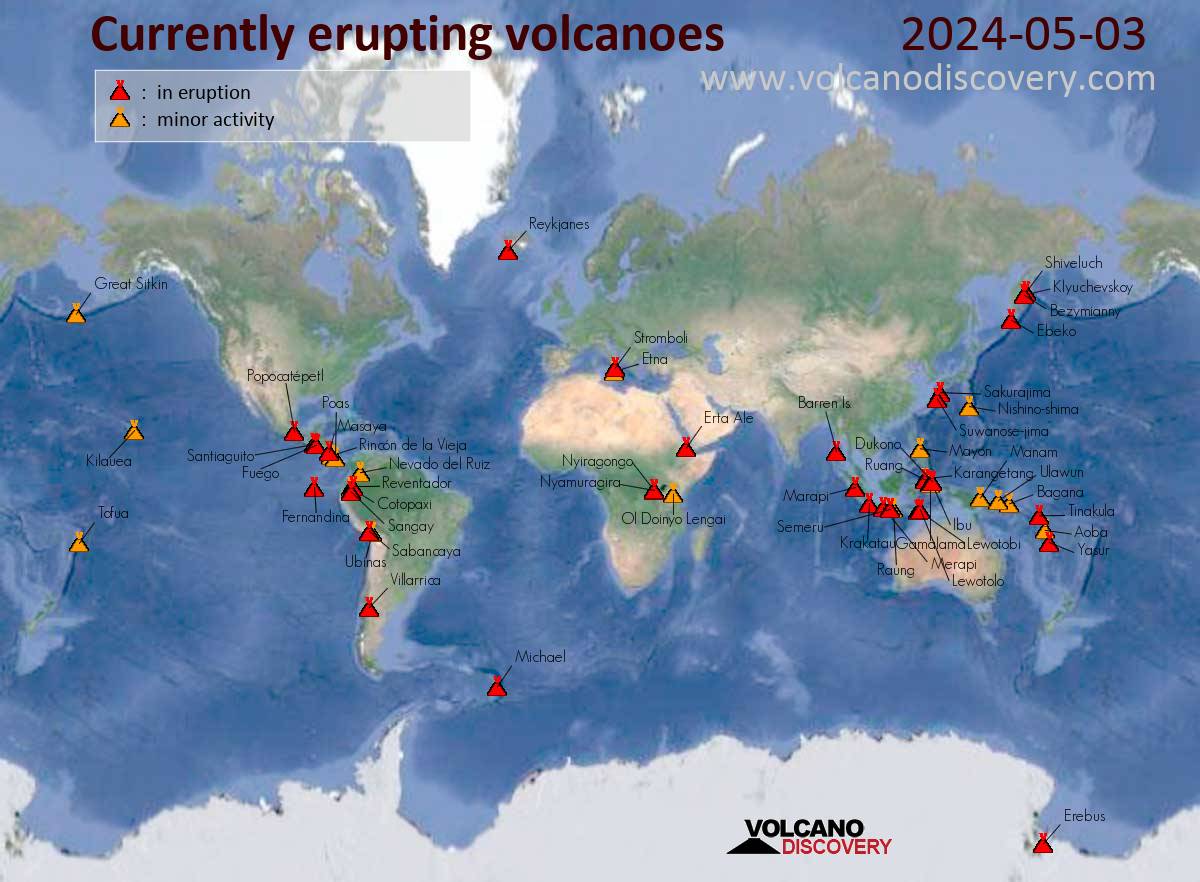
A very impressive 38 volcanoes around the world are at this moment erupting or showing activity, see map below, 34 of them around The Pacific Ring Of Fire
Indonesian colossus,Merapi Volcano eruption continues with a volcanic ash plume that rose up to estimated 40000 ft (12200 m) altitude or flight level 400. Mount Merapi volcano is Indonesia's most dangerous and active volcano. Yesterday, the volcano stepped up to the plate releasing its biggest lava flow since the Indonesian authorities raised the danger level back in November 2020. releasing a river of lava and gas flowing 1,500 metres, (4,900ft) down its volatile slopes.
After morning rain, ashfall turned into muck in several villages, where the sound of eruption on Wednesday could be heard 30 kilometres away. Police and rescue services told miners to cease work along rivers but no one was evacuated. Authorities in November had evacuated nearly 2000 people living on the mountain in Magelang and Sleman districts on Java Island but most have since returned. The alert was being maintained at the second-highest level and authorities told people to stay out of the existing 5km danger zone around the crater as the local administrations in Central Java and Yogyakarta provinces closely monitor the situation. The 2968m volcano is on the densely populated island of Java and near the ancient city of Yogyakarta. It is the most active of dozens of Indonesian volcanoes and has repeatedly erupted with lava and gas clouds recently. Merapi's last major eruption in 2010 killed 347 people. Indonesia is prone to earthquakes and volcanic activity because it sits along the Pacific "Ring of Fire," a horseshoe-shaped series of seismic fault lines around the ocean.
Europe's most active and largest volcano, Mount Etna remains highly active, erupting from at least two of its summit craters: although visibility has been very poor, intermittent clear views allow to see intense strombolian-type activity from the New SE crater and the Voragine central crater. The latter is less frequent and not as strong as the activity at the protagonist New SE crater. Tremor has been high and showing a steady increasing trend, indicating that magma is currently flowing towards the surface at an increased rate. Whether there will be another paroxysm with lava fountains soon is open to speculation at the moment.
Spectacular eruptions of red lava from Mount Etna, on the Italian island of Sicily, continued overnight from Monday into Tuesday, illuminating the night sky. The volcano’s lava fountains soared to 1,500 metres, according to the Etna Observatory at Italy's National Institute of Geophysics and Volcanology.
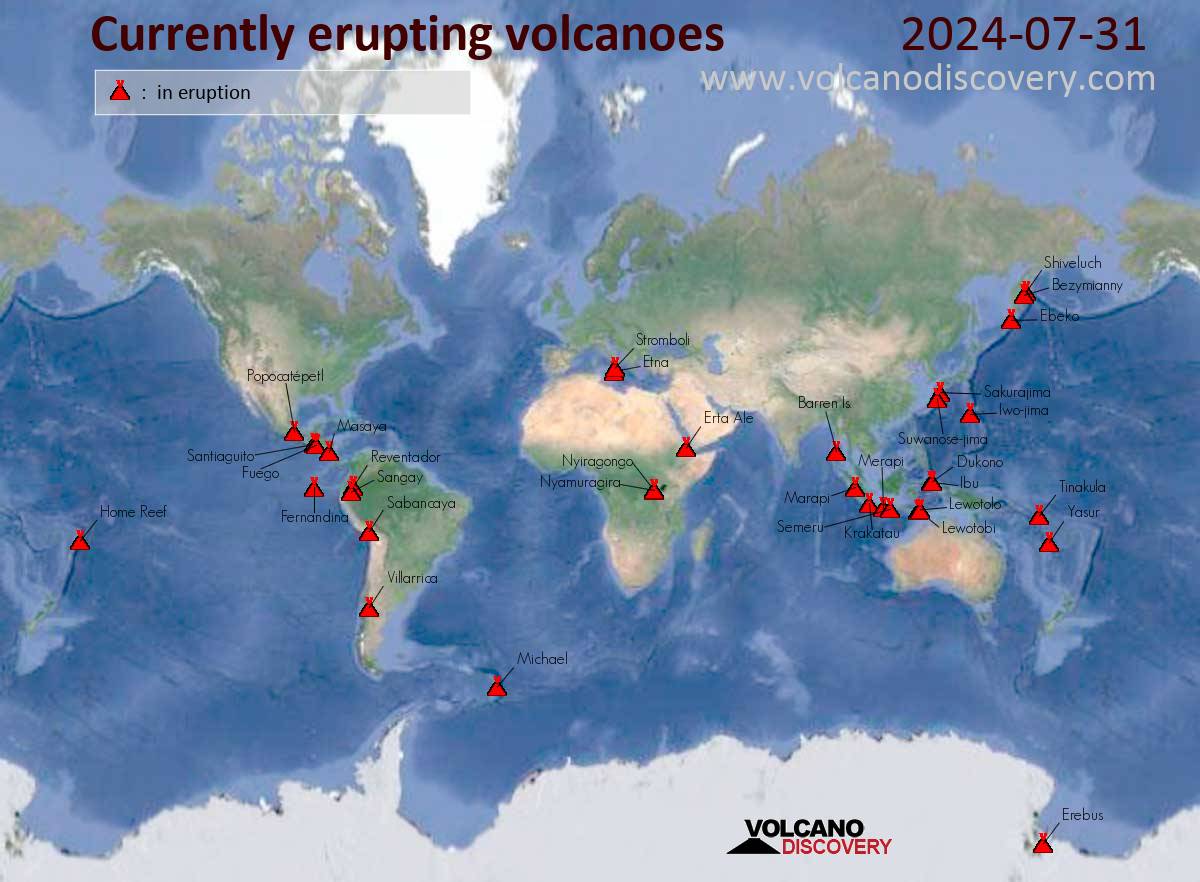
There are currently 28 volcanoes erupting around the world at this moment and 25 of them are in the Pacific Ring Of Fire. 2021 has seen an impressive uptick in seismic and volcanic activity.
The Etna volcano on the Italian island of Sicily has put on a spectacular show, spewing fire and ash in the air after an explosion on the volcano's southeastern side. Local media and social media users shared photos and videos of the event that showed a huge smoke cloud rising from the crater and lava flowing down the slope.
No injuries or damages were reported. According to the news agency Adnkronos, the lava flow had reached an altitude of 2000 metres. The airport in Catania temporarily ceased operations due to ash in the air. The Ansa news agency reported that a column of smoke and ash had risen more than a kilometre into the air, making it unsafe to fly. Ash rained down on houses, streets and balconies across the city. It's not uncommon for Etna, which is 3300 metres tall, to erupt. The volcano in eastern Sicily is considered a UNESCO world heritage site.
Popocatepetl Volcano eruption yesterday, credit Webcams de Mexico
A spectacular burst of volcanic activity around the world just before Christmas has enthusiasts excited after a fairly quiet year.
Hawaii's Kilauea volcano has roared back to life, creating a lava lake that has been growing several meters per hour, the US Geological Survey said on Monday. The eruption started after a 4.4 magnitude earthquake struck the volcano's south flank a day earlier.
The Halemaumau crater of the volcano is shooting lava, gas and ash into the air. A particularly vigorous eruption occurred within an hour when lava poured into a crater and mixed with the water accumulated inside, Tom Birchard, a senior forecaster with the National Weather Service, Hawaii, told The Associated Press.
Birchard added that a steam cloud as high as 30,000 feet (some 9,150 meters) had shot into the atmosphere.
The recent volcanic activity at Italy’s Mount Etna intensified overnight, as a large stream of lava spewed out westward from Europe's largest and most active volcano, putting local residents on edge as 2020 draws to a close.
The eruption at the 3,329-meter (10,922-foot) volcano’s southeast crater reignited, resulting in yet another lava-fountaining episode (known as a paroxysm), lighting up the Sicilian skies in the early morning, before filling them with thick clouds of smoke and ash.
The paroxysm was shorter but stronger than the event on December 13 and was accompanied by a sharp peak in a seismic activity which lasted for around two hours.
According to some reports, the recent activity could mark the beginning of a new cycle of increased paroxysms at the volcano in the coming days and weeks, not ideal news for beleaguered local residents as the end of 2020 comes so agonizingly close.
More than 500,000 people live around the base of Mount Etna which has a history of violent eruptions and is one of the most active volcanoes on earth.
Sheveluch volcano (Kamchatka, Russia): powerful eruption; emissions to 28,000 ft.
A spectacular volcanic explosion occurred from the crater at 12:20 local time today as volcanological observatory KVERT reported. The plume of ash rose to an altitude of 16,000 ft (4,876 m) and formed a relatively large umbrella region in the upper part of the eruption column.
A few hours later, at 19:30 local time on today evening, another strong explosion detected by Volcanic Ash Advisory Center (VAAC) Tokyo produced a spectacular ash plume rising up to 28,000 ft (8,500 m) altitude and extended about 130 km to the southeast of the volcano.
Incandescence continues to be observed in the crater identified in satellite data.
The volcano's lava dome remains in a very active state. Volcano discovery.
Sabancaya volcano Peru has erupted and has spewed ash and gas emissions to 24000 ft (7300 m)
Wed, 23 Dec 2020. Explosive activity continues. Volcanic Ash Advisory Center (VAAC) Buenos Aires warned about a volcanic ash plume that rose up to estimated 24000 ft (7300 m) altitude or flight level 240 and is moving at 10 kts in SW direction.
In Mexico, the Popocatepetl volcano is causing concern after a large eruption spewed a volcanic ash plume that rose up to estimated 19000 ft (5800 m) altitude or flight level 190. Wed, 23 Dec 2020, 09:15
09:15 AM | BY VN
Explosive activity continues. Volcanic Ash Advisory Center (VAAC), see image above.
The Sakurajima Volcano in Japan is currently erupting.
Strombolian explosions become stronger than the average size of explosions at the volcano and more frequent at regular intervals of 2 to 4 per hour during the past few weeks.An explosion generated an ash plume which reached approx. 1,968 ft-3,937 ft (600 m-1,200 m) altitude and drifted SW. Some of the lava bombs were ejected as far as 800 m away from the crater. In addition, the activity is accompanied by a strong glow from the Otake crater that suggesting a rise of the flux of magma within the volcano. The warning bulletin states that ballistic impacts of volcanic bombs and pyroclastic flows could affect an area of about 1 km distance from the main crater.
Hundreds of people living near a volcano in southern Peru have been evacuated after it erupted and spread ash on Friday.
The Ubinas Volcano, the most active in Peru, recorded two explosions since dawn, which spewed ash and affected more than eight surrounding areas.
Peruvian President Martin Vizcarra called for the evacuation, describing it as "a major event unlike any we have had in recent years."
The Geophysical Institute of Peru forecast that the volcano's activity will escalate in the following days with stronger eruptions and more ash emissions coming.
The volcano, which is 5,672 meters high and located in the Moquegua region, saw its more active period from 2013 to 2016.
Meanwhile, Mount Bromo in East Java erupted on Friday evening, coupled with cold lava flows owing to rains.
The 2,329-meter-high volcano erupted for a duration of some seven minutes from 4:37 p.m. local time, but the height of the ash column was not observed, Chief of the Volcano Mitigation Section of the Center for Volcanology and Geological Hazard Mitigation (PVMBG) Hendra Gunawan remarked on Friday night.
The seismogram recorded the eruption at a maximum amplitude of 37 millimetres, lasting for a duration of some 14 seconds, he noted.
"The eruption of volcanic ash, lasting for about seven minutes, produced tremor.
However, once the eruption stopped, the tremor was not recorded, and (the seismogram) no longer showed tremor," he remarked.
He revealed that the alert status of Mount Bromo, which straddles the three districts of Probolinggo, Pasuruan, and Malang, was returned to the earlier Level 2 (caution), and those residing around the volcano and tourists were banned from entering a one-kilometre radius from the crater's peak.
Head of the Jember District Disaster Mitigation Office (BPBD) Anggit confirmed that he had been informed of Mount Bromo's eruption.
However, the height of the volcanic ash column was not observed due to the fog.
"Rains also fell on the southern part of the crater, causing cold lava flows into the sea.
Italy's Mount Etna, Europe's biggest live volcano, erupted overnight with lava flows and explosive burps, according to vulcanologists.
A heavy emission of ash into the sky forced the closure of two airports in Sicily's second-biggest city of Catania.
They partially reopened early this morning.
The activity followed "lively spattering" recorded by the National Institute of Geophysics and Vulcanology in early June and a previous eruption in December last year.
Eruptions are frequent, and the last major one dated back to early 2009.
The institute said this latest eruption was intermittent and the lava was flowing around 1.5km down a desertic escarpment called the Valle del Bove (Ox Valley) from craters situated on the volcano's southeast face.
We have to go back to back to September 2015 the last time we had more than 22 major quakes in one month when 23 was registered.
A magnitude 6.2 - 99km SE of Kupang, Indonesia is the 22nd major quake of August and the 72nd of 2018 and the 5th in the Indonesia area this month.
The quake comes as Earth's magnetic field is quieting, finally, almost 48 hours after a surprisingly strong geomagnetic storm sparked auroras seen from the Arctic Circle to the continental USA. August has seen a plethora of major quakes and volcanic activity, unprecedented in my years as a blogger and the quakes keep coming... According to Spaceweather.com, a strong G3-class geomagnetic storm has been in progress since Aug. 26th as Earth passes through the wake of a CME that arrived with little fanfare as it was unexpected. Strong magnetic fields in the CME's wake have opened a crack in Earth's magnetosphere, allowing solar wind to enter and causing seismic and volcanic disturbances, (IMHO) Once again the quakes come as our Earth is inside a stream of solar wind flowing from a massive coronal hole.
An incredible surge of major quakes has hit the planet in the last two weeks after an incredible low count this year up to the beginning of August when a flurry of major quakes have been registered around the world coming entirely out of the blue.
The surge of major quakes does, however, coincide with three enormous coronal holes which have been spewing solar wind at the Earth's magnetosphere during the same period of the quake flurry.
Just two weeks ago 2018 was on course to register the lowest count of major quakes this century.
A flurry of major quakes has been registered in a two week period when a massive coronal disturbance on our Sun has ejected a stream of solar wind from two giant holes on our Sun's atmosphere. Today's major quakes bring the total in August to 22, easily the most in one month this year with the annual total to 72 so far. Along with the quake activity August has seen an uptick in volcano activity too, the volcano on Papua New Guinea's Manam Island erupted again as well as Mount Etna the most famous and biggest volcano in Europe. Earlier in the month, Japan's Meteorological Agency said volcanic earthquakes and sulphur emissions had increased at a peak on Kuchinoerabujima island, located roughly 1000km southwest of Tokyo. Nearly two dozen quakes at the gigantic Katla volcano in Iceland had experts worried this month which is long overdue for an eruption and the deadly Fuego volcano in Guatemala which killed 300 causing thousands to be evacuated two months ago erupted yet again on in early August. At the beginning of the month, the Karymsky Volcano Kamchatka in eastern Russia exploded plumes of ash spreading almost 100 km And on the 1st of August Mexican colossus the Popocatepetl volcano spewed ash and smoke two kilometres high threatening 30 million people. Quakes