Showing posts sorted by relevance for query Canada major quake. Sort by date Show all posts

Tuesday, 24 December 2019

The 1,490th major quake of this decade belongs to British Columbia, Canada: A magnitude 6.0 quake is the 7th of December and the 139th of 2019

Map USGS

A magnitude 6.0 quake hit off British Columbia on Canada’s western coast on Monday with no reports of damage, Natural Resources Canada said. The powerful quake was very shallow and centred 178 km (111 miles)west of Port Hardy. No tsunami warning was issued.

Last nights quake, could well be the last major quake, (Mag 6 or higher) of the decade and the last of 2019, indeed the last of December.

The magnitude 6.0 quake is the 7th major quake of December and the 139th of 2019 it is also the 1,490th major quake of this decade. The number of major quakes for the first decade of the 21st century was 1,588, which is 98 more than the 2nd decade with just 7 days remaining of 2019. 3.078 major quakes have occurred since January 1st, 2000.

The decade began with an immense disaster in Haiti, already the poorest country in the Western hemisphere. A devastating, 7.0 magnitude earthquake hit the island on January 12, killing hundreds and thousands of people (220,000 according to Haitian Government figures), and causing severe damage to buildings. UN News

Major Quakes

Home Page 

Thursday, 4 July 2019

Tourists jump into the sea in panic as Italian volcano erupts: A powerful mag 6.2 quake off the west coast of Canada: Major quake and volcano activity uptick continues

Credit ANSA

A volcano on the island of Stromboli, Italy has erupted, throwing ash high into the sky, with tourists reportedly throwing themselves into the sea in panic.
Italy's ANSA news agency reported that tourists, frightened by the unexpected explosion on the small Mediterranean island, had thrown themselves into the sea.
It said two new lava spouts are creeping down the volcano on the famed island.
The volcano was also shooting out red-hot rocks called lapilli, local sources said.
One eyewitness added: "A huge column of dense black smoke is coming out of the crater."
Another said: "There was a powerful explosion.
We heard a bang, then a column of smoke and lapilli fell onto Ginostra, and flames on the slopes of the volcano".
Fires have broken out across the island, according to fire services and forest rangers.
It's not a particularly active volcano, so that's a surprise." Michela Favorito, who works in a hotel near Fico Grande, on the east side of the island, said: "We saw the explosion from the hotel.
There was a loud roar.
"We plugged our ears and after this, a cloud of ash swept over us.
"The whole sky is full of ash, a fairly large cloud."

Meanwhile, a powerful shallow, magnitude 6.2 rocked the west coast of Canada continuing the increase in major quake activity recently.
Last night's quake was the 79th major quake of 2019, which is 35 more than the same period last year and 32 more than the same period in 2017.

As we move into July the uptick in volcano activity has suddenly spiked.
Alert Level Raised at Hawaii's Mauna Loa Volcano, the World's Largest Active Volcano.
Federal officials raised the alert level Tuesday for the world's largest active volcano, Hawaii's Mauna Loa, which last erupted in 1984.
The U.S. Geological Survey changed the level from "normal" to "advisory" following a steady increase in earthquakes and ground swelling that began in March.
Meanwhile, at least 16 volcanic quakes and six rockfall events on the Mayon Volcano were recorded by the Philippine Institute of Volcanology and Seismology (Phivolcs), signifying a renewed abnormal behaviour since its last eruption in January last year. In its bulletin on Tuesday, Phivolcs said the volcano's seismic monitoring network recorded the quakes and rockfall events in the last 24-hour observation period.
Peruvian scientists are registering a 100 to 120 seismic events per day in the volcano of Ubinas, which is a sign of increasing eruptive activity of the volcano, Hernando Tavera, executive president of Peru's Geophysical Institute (IGP), told Sputnik.
Last week, IGP warned about the intensified eruptive activity of the Ubinas volcano and issued a recommendation for local authorities to raise the alert level over a possible eruption. "Currently we are registering from 100 to 120 seismic events in Ubinas, while earlier we recorded one [seismic event] per day ...
At the same time we should take into account that Ubinas is a very active volcano," Tavera said.
He added that Ubinas was the most active volcano in Peru.
Mount Merapi, which located at the border area of Yogyakarta Special Region and Central Java, spewed a lava avalanche on Sunday up to 850 meters in distance, according to the Geological Disaster Technology Research and Development Center (BPPTKG).
Lava avalanche monitored by surveillance cameras during the observation period from 12:00 to 6:00 a.m Western Indonesian Time (WIB) was flowing upstream of Gendol River, the Head of BPPTKG Hanik Humaida stated. During the observation time, there were also two volcanic earthquakes monitored with amplitude ranging between 4 to 27 millimetres and lasting between 41.8 to 85 seconds.
Meanwhile July's first major quake, a mag 6.0 struck Vanuatu yesterday close to one of the most active volcano area in the world.

June saw a large uptick in volcano activity accompanied by a spike of major quakes around the Pacific Ring Of Fire.
A total of 18 major quakes with all of them recorded around the Pacific Ring Of Fire were registered in June, the largest number of major quakes recorded in one month this year.
A total of 78 major quakes have been recorded this year so far.

Volcanoes

Front Page
 

Monday, 4 March 2024

March has its first major quake (mag 6 or higher)—A magnitude of 6.7 south of New Zealand—2024 has been slow on seismic activity despite the incredible amount of solar activity this year so far: Could the West coast of America be due a big one?

Credit USGS

March has its first major quake (mag 6 or higher)—A magnitude of 6.7 south of New Zealand, see the image above. It is only the 17th major quake, (mag 6 or higher) in 2024 with only four being reported in the whole of February. . . By this time last year, 28 major quakes had been reported so you can say it's a slow start to the year, especially when you consider the incredible amount of solar activity we have witnessed this year. (Solar activity is thought to cause seismic activity here on Earth, according to some scientists)

Mag 5s fair no better with the same period last year—291 in 2023 compared to 239 in 2024. Since the first of November last year 45 major quakes have been recorded and all but 4 have been recorded around the Pacific Ring Of Fire.   

The last major quake to hit the West coast of North America was a shallow (7km deep) mag 6.0 SW of Port McNeill, Canada on 2023-04-13.

Possible Interrelations of Space Weather and Seismic Activity

As I mentioned above, Solar activity is thought to cause seismic activity here on Earth, according to some scientists at least, well, a new paper has just been released suggesting just that—Possible Interrelations of Space Weather and Seismic Activity: An Implication for Short-term Earthquake Prediction.

Abstract:

Abstract The statistical analysis of [the] impact of the top 50 solar flares of X-class (1997-2023) on the global seismic activity, as well as on the earthquake preparation zones located in [an] illuminated part of the globe and in the area of 5000 km radius around the subsolar point was carried out. It is shown by a method of epoch superposition that for all cases the increase of seismicity is observed, especially in the region around the subsolar point (up to 38%) during 10 days after the solar flare in comparison with [the] preceding 10 days. The case study of [the] aftershock sequence of strong M=9.1 earthquake (Su-matra-Andaman Islands, 26.12.2004) after the solar flare of X7.2 class (20.01.2005) demonstrated that the number of aftershocks with magnitude M≥2.5 increases more than 20 times after the solar flare with a delay of 7 days. For the case of the Darfield earthquake (M=7.1, 04.09.2010, New Zealand) it was shown that strong solar flares of class X and M probably triggered two strong aftershocks (M>6) with the same delay of 6 days on the Port Hills fault, which is the most sensitive to external electromagnetic impact from point of view of the fault electrical conductivity and orientation. Based on the obtained results the possible application of natural electromagnetic triggering of earthquakes is discussed for a short-term earthquake prediction using confidently recorded strong external electromagnetic triggering impacts on the specific earthquake preparation zones, as well as ionospheric perturbations due to aerosol emission from the earthquake sources recorded by satellites.

PDF File here


Saturday, 6 July 2019

"This is an earthquake sequence -- it will be ongoing!" A Mag 7.1 quake rocks Southern California after Thursday's Mag 6.4 produced more than 1,400 aftershocks

Map USGS showing hundreds of aftershocks in the vulnerable area

A 7.1-magnitude earthquake hit Southern California on Friday night -- the second one about 11 miles from Ridgecrest in the Mojave desert in less than two days.
The latest earthquake occurred 11 miles northeast of Ridgecrest, according to the US Geological Survey.
It comes a day after a 6.4-magnitude earthquake centred near Ridgecrest rattled the state Thursday, and a swarm of more than 3,000 earthquakes hit the same California area in June according to USGS. Full story

The mag 6.4 earthquake has produced more than 1,400 aftershocks, scientists said. Full story
The mag 7.1 earthquake is just one day after a 6.4 earthquake struck the area, and Friday's quake was along the same fault lines.
Friday's quake struck at 8:19 p.m. PT.
The quake shook downtown Los Angeles, and the Los Angeles Fire Department reported "localized" power outages in the city as well as downed wires.
There is no major damage to infrastructure, the LAFD said.
The quake was felt as far away as Las Vegas and Mexico, the USGS said.
More than 1,000 aftershocks have been recorded since Thursday's earthquake.
Thursday's quake is now known as a "foreshock" when an aftershock is larger than the original quake.
Lucy Jones of California Institute of Technology's seismology lab said in a press conference Friday that a magnitude 6 aftershock would be "not surprising."
"This is an earthquake sequence -- it will be ongoing," Jones said.
A tsunami warning is not expected.
This is the strongest earthquake recorded in the area in over 20 years.

Meanwhile, on Thursday a powerful shallow, magnitude 6.2 rocked the west coast of Canada continuing the increase in major quake activity recently. Full story

This morning's powerful quake is the 4th major quake to strike in July and with the large uptick in volcanic activity around the Pacific Ring Of Fire in the last couple of weeks is a major worry for scientists.
2019 looks set to be a bumper year for major quakes with this year's total of 81 now almost double the amount of 2018 up to the same time period.


Major Quakes

Home Page


Saturday, 30 December 2023

A high-pressure system stretching a mind-blowing two-thirds of the planet, encompassing, Canada, the Arctic, Greenland, Siberia, East and Western Europe to the Atlantic has been captured while locating the latest major quake—A mag 6.3 in Indonesia


Earthwindmap/USGS

An incredible high-pressure system stretching a mind-blowing two-thirds around the planet, encompassing, Canada, the Arctic, Greenland, Siberia, East and Western Europe to the Atlantic has been captured on the Earthwindmap while locating the latest major quake—A mag 6.3 in Indonesia, itself occurring during a torrential rain-storm. 

The high-pressure system seen above shown by the red line is a phenomenon I have never seen, it's enormous!

Meanwhile, the major quake, (mag 6 or higher) was the 147th of this year and followed another familiar pattern of 2023, namely—Of the 147 major quakes recorded this year, an incredible 102 of them have been on the Western side of the Pacific Ring Of Fire, which, if my maths are half decent, makes that almost two-thirds of all major quakes this year!

Credit, Earthwindmap/USGS

Incredible statistics from an incredible year, Happy New Year folks and I look forward to seeing you in 2024!

Home


Recent Posts


Thursday, 25 January 2018

A mag 6.2 - Russia rocks the Pacific ring again! It's now 6 major quakes and 6 extremely active volcanoes in the last 7 days: Disaster imminent?

Earthwindmap Click on image to enlarge


  • 6 major quakes in 7 days circling the entire Pacific ring.
  • 6 extremely active volcanoes with at least 2 claiming massive eruption imminent.
  • California gets lucky again


The mag 6.2 - 38km NE of Nikol'skoye, Russia this morning is yet another major quake on the Pacific rim, the 6th in the last 8 days, see above, add to it the 6 most active volcanoes and it's easy to see the Pacific ring of fire is bursting at the moment.

With the Mayon volcano in Indonesia and the Kadova Island volcano Papua New Guinea expecting imminent explosions and three major quakes in 24 hours including the powerful Alaskan quake something big could be in the offing.

The whole Pacific Ring is rumbling, from Alaska to Papua New Guinea and Chile to Russia and Philippines to Mexico with one exception, once again the US West coast has come away unscathed but for how long?
With nearly 200,000 people evacuated or affected by Pacific Ring volcano activity and the fact that millions got lucky along US and Canada coast once again yesterday when a massive 7.9 quake rocked Alaska, we must surely be asking ourselves when not if will the big one strike!.

Today's major quake is the 9th major quake to strike our planet this month and of course 2018.
And with the Earth still exiting a stream of fast-moving solar wind from the recent Coronal hole, today's and yesterdays quake has recorded an impressive 9 from 9 major earthquakes this year to have occurred during solar wind and or a coronal hole influencing the Earth's magnetosphere.
It is a Big Wobble project this year to document just how many major quakes occur during a coronal hole facing Earth, so far so good, it's 9 from 9, 100 %.

Home

Sunday, 31 December 2023

Signs and Wonders—The incredible Polar stratospheric clouds (PSCs), thought to be the most beautiful clouds on our planet, seen over Europe last week were due to record-breaking cold in our stratosphere. . . Major quake watch for North Pacific

First documented appearance of Polar stratospheric clouds over Switzerland and Italy, seen from Brissago, Ticino, Switzerland 22 December 2023. Author—Karin Switzerland.

The incredible Polar stratospheric clouds (PSCs), thought to be the most beautiful clouds on our planet, suddenly exploded over Europe last week due to record-breaking cold in our stratosphere—According to NASA's MERRA-2, temperatures in the Arctic stratosphere hit a 40-year record low for December—Normally, the stratosphere has no clouds at all. But when the temperature drops to a staggeringly low -85 C, widely-spaced water molecules coalesce into ice crystals and PSCs begin to form. Normally PSCs are confined to the Arctic where the stratosphere is the coldest. However, the record-breaking cold stratosphere made sure the magnificent clouds could be seen in many parts of Europe. 

Above is a screen grab from Earthwindmap showing a temp of minus 77 deg C, (minus 106 deg F) at 70 hPa on Christmas Eve in Scandinavia.

According to NASA satellite data, the record-cold spell in our stratosphere is over which is good news for the northern hemisphere. A warmer stratosphere indicates the polar vortex is weakening.

According to Spaceweather.com—2024 could begin with a geomagnetic storm. NOAA forecasters say that minor G1-class storms are possible on Jan. 1st.

Major Quake Watch. . .

Possible chance of a major quake/s in these low-pressure areas in the North Pacific, credit, EarthWindMap.


Recent Posts


Wednesday, 24 January 2018

Fukushima rocked as a mag 6.2 hits Mutsu Japan: The Pacific ring is on fire! 3 major quakes in 24 hours and 3 potentially massive volcano eruptions

Credit USGS
The Pacific ring is on fire!
The Pacific ring of fire continues to alarm as the third major quake in 24 hours rocks the Fukushima nuclear palnt with a mag 6.2 hits Mutsu Japan.
It could be seen as another lucky break for millions of people as was the millions who got lucky along US and Canada coast once again yesterday when a massive 7.9 quake rocked Alaska.
Japan was also rocked when Mount Kusatsu-Shirane erupted yesterday killing 1 and injuring 11 some of them critical with at least 78 skiers still trapped as exploding rocks caused an avalanche.
And we must not forget the 80,000 people in a state of "zero visibility" living with explosion-type earthquakes which have caused 61,000 to be evacuated as the volatile Mount Mayon volcano prepares to blow, as well as The Papua New Guinea Kadovar island volcano remaing "dynamic" with white steam plume rising.
Todays major quake is the 8th major quake to strike our planet this month and of course 2018.
Todays earthquake is also the first major quake this year to occur without a coronal hole facing Earth!
It is a Big Wobble project this year to document just how many major quakes occur during a coronal hole facing Earth, so far, it's 7 from 8, not quite 100 %.


Home

Tuesday, 23 January 2018

A massive mag 8.2 reduced to mag 7.9 hits the coast of Kodiak causing a tsunami panick to Alaska and the entire western coast of Canada and US

USGS
A huge earthquake of magnitude 8.2, reduced by USGS to a mag 7.9 struck 256 km (157 miles) southeast of Chiniak, Alaska at a depth of 10 km this morning.
A tsunami warning for southern Alaska and the entire western coast of Canada and the US has been issued.
Officials in Anchorage warned coastal areas, saying there was "extraordinary threat to life or property".
The alert told people to seek refuge on higher ground in affected areas.
Tsunami sirens could be heard in Kodiak.
The National Dater Buoy Centre shows a huge spike in the sea as the quake struck in the area of Kodiak, see below.


The magnitude 7.9 off the coast of Alaska is the second major quake today after a mag 6.1, reduced by USGS to a mag 6.0 hit Indonesia this morning, it brings the total to seven major quakes this month and 7 for 2018.
Today's major quake comes at the back end of a coronal hole on our Sun
For the second day in a row, a stream of solar wind is blowing around Earth faster than 500 km/s (1.1 million mph) as the coronal hole begins to turn away from facing Earth.
All seven major quakes this year have come as a coronal hole faced the Earth.
It is a Big Wobble project this year to document just how many major quakes occur during a coronal hole facing Earth, so far, it's 7 from 7, 100 %.
Below is an SDO picture showing the coronal hole on our Sun

Credit SDO


Tsunami siren in Kodiak after the quake


Home

Monday, 1 January 2024

JAPAN TSUNAMI UPDATE—LIVE VIDEO: The earthquake's magnitude of 7.6 is the largest recorded in the Noto Peninsula in Ishikawa prefecture since records began in 1885—Powerful aftershocks are ongoing at the moment bringing the possibility of another mag 6+!


Tsunami warnings for the entire western coast of Japan are in place at the moment

The Japan Meteorological Agency (JMA) issued tsunami warnings for the coastal prefectures of Ishikawa, Niigata and Toyama, marking the first major warnings since the March 2011 earthquake and tsunami that struck northeastern Japan.  A major tsunami warning means waves of more than three meters are possible. Russia also issued tsunami warnings in its far eastern cities of Vladivostok and Nakhodka.

Live Updates. . .

The earthquake's magnitude of 7.6 is the largest recorded in the Noto Peninsula in Ishikawa prefecture since records began in 1885, Japan's Meteorological Agency says.

A massive earthquake with a preliminary magnitude of 7.6 hit central Japan on Monday, triggering a tsunami warning and advisories for residents to evacuate. 
 

There has been a barrage of fairly powerful aftershocks, which are ongoing at the moment with the possibility of another mag 6+ or higher, see USGS map below. . .


Major Quake Outlook

EarthWindMap.

While the deep low-pressure area has been replaced with a dominant high-pressure system there is still the possibility of powerful aftershocks all around the vicinity of Japan.

The deep-pressure system across the North Pacific area of Russia, the Aleutian Isles, Alaska and Canada could cause major quake activity in the following hours.


Recent Posts


Wednesday, 25 December 2019

Waiting for the big one! The 3rd major quake strikes the coast of British Colombia in just over 24 hours in the area where Canada's largest earthquake- a mag 8.1, occurred in 1949

Map USGS

Another major quake has struck, west of Port Hardy, British Columbia last night making it 3 major quakes in just over 24 hours in the area where Canada's largest historical earthquake- a magnitude 8.1, occurred on August 22, 1949. 3 large aftershocks have been registered with one, registered at magnitude 5.7. There were no immediate reports of injuries or damage from the quake, which were all registered at 10 km deep, according to USGS. There is no current tsunami warning in effect, according to the Pacific Tsunami Warning Center.

Major Quakes

Home Page 


Wednesday, 8 September 2021

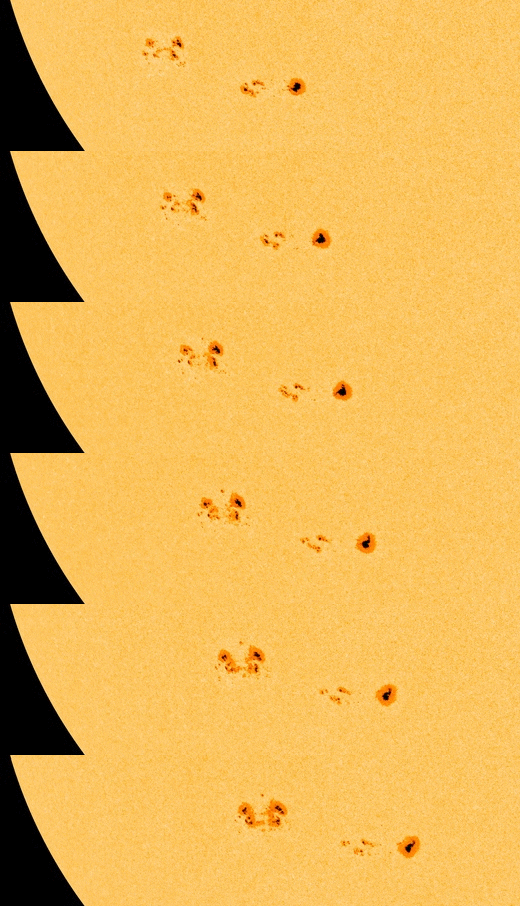
THESE SUNSPOTS COULD SWALLOW PLANETS: Solar Cycle 25 springs to life with massive sunspots AR2866 and AR2868 growing rapidly and turning to face Earth and producing a C-class flare which coincided with a mag 7.0 quake in Mexico's Acapulco area: Big sunspots can produce big flares

Sunspots AR2866 and AR2868 are crackling with C-class solar flares. Credit: SDO/HMI

It is a few years since we have seen sunspots this big on the face of our sun. Big sunspots can produce big flares. For the rest of this week, the two will be squarely inside the Earth strike zone. Any flare or CME would be a direct hit buffeting Earth's weakening magnetosphere.

THESE SUNSPOTS COULD SWALLOW PLANETS: Spaceweather.com is claiming these sunspots AR2866 and AR2868 are growing rapidly and turning to face Earth. This movie from NASA's Solar Dynamics Observatory shows their development during the past 24 hours:

How big are they? The entire planet Jupiter could fit comfortably between the primary cores of AR2868 (on the right). AR2866 (on the left) might soon be even bigger. The active region has almost doubled in size since yesterday.

The massive sunspots on our sun have produced a gust of solar wind which buffeted Earth's magnetic field on Sept. 7th around 1400 UT. The sharp uptick in solar wind speCed was unexpected, arriving too soon to be a CME from the B7-class solar flare only two days earlier.

Less than 16 hours earlier an alert was falsely generated by an automatic system at USGS claiming a mag 6.5 had occurred off the coast of British Columbia, in Canada, however the major quake alert was removed by USGS, see picture below. It was quickly confirmed to be false and manually deleted. USGS say they will update this page when we know details of the error.

Click on image to enlarge.

However, last night at around 12.00/1.00 UTC, our sun produced a medium-size C-class solar flare which coincided with a mag 7.0 quake in Mexico, see graph below.

Credit Space Weather Prediction Centre.

Credit USGS

The powerful earthquake shook the beach resort of Acapulco damaging buildings and causing at least one fatality. Yesterday's quake was the first major quake, (mag 6 or higher) of September and the 108th of 2021, according to USGS.


Thursday, 13 August 2026

Signs and Wonders! Could this record-breaking warmth be the coolest summer of the rest of your life? Temperatures of 65 °C (149°F) will be quite possible in 20 years. It's a mess! From the beginning of birth pangs to seismic convulsive seizures. The world is shaking! Both sides of the pond are burning up: Time Appears To Be Accelerating as World leaders are acting rather strangely

Time-lapse sequence from Logroño, Spain—Wikipedia

From the beginning of birth pangs to seismic convulsive seizures.  The 96% Solar Eclipse filmed on Wednesday evening 12/8/2026 by my daughter and son-in-law on the West Coast of Holland . . . The last time I saw anything like this was 27 years ago in Northern Spain. Yesterday I got lucky again . . .

A seven-month sabbatical from commentary may not seem like a long time to many of you; however, we are living in truly unprecedented times. I have been away for a while, but the change I've seen is like reading a whole chapter of Biblical Prophecy unfolding before my eyes. In the time I was away, I have seen nations rise against nations, and an increase in wars and rumours of wars, signs and wonders in the heavens and earthquakes in diverse places. As for the climate sceptics, it's been a summer of heatwaves, everywhere in the Northern Hemisphere, and the 'experts' are claiming 2026 will be the hottest year ever . . . (They say that every year these days!)

Behold A Pale Horse

Have they been released? I have seen an escalation of violence from the four horses of the apocalypse, with the conqueror on the white horse being especially busy. 

The red horse with the big sword symbolising war and bloodshed has been working overtime . . .

The third horse, the black one representing famine, is also extremely busy with prices of everything, everywhere going through the roof.

And the sickly horse, "BEHOLD A PALE HORSE", is working away in all ways possible to be the bringer of death—mostly through pestilence.

Christian Breur, Holland.

Only 8 survived the flood!

Of course we don't know when the end times will arrive; apparently they will get much worse than they are now. Jesus said the end times will be much worse than the times of Noah, which is kind of worrying when you realise only eight people and lots of animals survived the flood. 

World leaders are acting rather strangely and making extreme fantasy decisions.

In just seven months I have witnessed a world where the clock appears to be accelerating faster than a speeding bullet, and where world events are extremely unpredictable and frighteningly dangerous. World leaders are acting rather strangely and making extreme fantasy decisions. (Have they gone mad?) Our planet is changing too, both geophysically and politically, socially and environmentally; every hour of every day the birth pangs accelerate. Breaking News is breaking briefly before the next hyper-link arrives.

Quakes in diverse places

Even as I type this post, an extremely powerful Magnitude 7.4 quake - 5 km S of San José del Palmar- has just rocked Colombia, with the Governor claiming the situation is critical. Major quakes happen all the time; I understand that, however, this is the third Mag 7+ in this area in the last couple of months, which is unusual. The major quake has been recorded close to the country's massive Purace volcano, which is currently spewing ash hundreds of metres into the Colombian sky. Colombia is also suffering from extreme drought conditions this year too—prayers for the people there. 

Volcanic activity, in my experience, is at the moment showing unprecedented volatility, with around "SIXTY" volcanoes erupting or showing activity worldwide; see the picture above. I'm not an expert, but I can't ever remember these types of numbers in my eighteen years blogging. Let me tell you, the eruption count around the world is mostly around 40. So, just like the major quakes, volcanic activity is very active and inclining upward.

As for major quakes (MAG 6 OR HIGHER), don't let the so-called 'experts' pull the wool over your eyes; they are at an all-time high!

This year so far, 88 major quakes, mag 6 or higher, have been recorded. In the same period in 2020, 74 major quakes had been recorded. In the same period 100 years ago, 65 and in 1900, just 7. Of course, we do have to take modern technology into account, but even so! 

Burn Baby Burn

Here on the West Coast of Europe, along with the UK and Ireland, yet another heatwave is on its way. By Thursday, temps could well be hovering around 40 deg C, 104 deg F in the UK, Holland, France and Spain. HIGH STRANGENESS! For many in this year in the area, this will be the 5th heatwave this summer in just the last month and a bit. Many parts of Western Europe have now gone well over a month without any significant rainfall. Two-thirds of England is now under drought conditions, with conditions set to worsen. All the countries mentioned above have been on fire for weeks in scenes I have never seen before. One would expect France and Spain to burn, but Ireland, the UK and Holland? No, this is a new phenomenon. For me, in 18 years reporting the weather, this is unprecedented.

Canada is burning too. More than 950 wildfires are scorching Canada from coast to coast, according to the national wildland fire summary. Roughly 241 blazes are out of control. The fires have prompted Environment Canada to issue air quality warnings from B.C. to Quebec and the Northwest Territories.

The California season is yet to begin.

A super deluge from storms has brought flooding to Japan in what has been called 'unprecedented' rainfall, causing more than 20,000 people to be evacuated

Is this the coolest summer of the rest of your life?

Sounds crazy, I know, but the annual increase in temperatures every year could well mean this year's inferno (probably the hottest ever recorded) could well be the coolest summer of the rest of your life . . . 

Meanwhile, El Niño is responsible for record-breaking sea temperatures. The average sea surface temperature (SST) outside the world's polar regions - between 60 degrees north and 60 degrees south - was 20.96C last month, beating the previous high of 20.89C, set in 2023.

Last month was the joint second-warmest July globally on record, with temperatures 1.47C above the estimated pre-industrial average, according to the Copernicus Climate Change Service. South Korea has just reported temperatures nearing 45 deg C, 113 deg F.


As a Brit, my summer holidays are mostly spent in Southern Europe, France, Spain, Portugal or Greece. I started The Big Wobble back in 2008, ironically to cover climate change. Let me tell you, back then any temp over 35 deg C (95 deg F), even in Southern Europe, was considered shocking. Fast forward just 17 years later, and temperatures are regularly approaching 50 deg C (124 deg F) in the hottest months.

'Warning—The chapter below is not for the squeamish!

Let me put this into some kind of perspective: in the last 17 years, 1 deg C, or 1.8 deg F, can be thus added to the average temp every year; it's clearly undeniable. If the warming continues as it has done in the last 17 years, temperatures of 65 °C (149°F) or even higher will be quite possible. These temperatures are quite frankly unlivable, not just for us but all wildlife, including fish, plants, trees and more importantly, agriculture. Our whole ecosystem will have collapsed long before we reach these temperatures; what I'm saying is, quite simply, we are very quickly arriving (if we are not already there) at a tribulation period prophesied in the Bible thousands of years ago.

Over the years, I have noted Holland is getting hotter, not just in the summer but in winter too. Below are my honest views on a tricky subject. Temperatures here in many parts of Europe, especially the south, regularly exceed 40°F (104F). For countries further north, such as Belgium, Holland, Germany, etc, 40 deg C is extreme; however, it has become more common recently. Our infrastructure is not built for such temperatures, and most of us don't have airco, for instance. In the UK, where I was born, I am used to cool, wet summers, so when I arrived here in Holland in 1995 I was pleasantly surprised by the long summers and wonderful sunshine. But even so, back then, if the mercury reached anything close to 30  deg C (86F), it was quite special and didn't happen very often.

Ten years later, the highs were pushing 35 deg C (95F). In the two-thousand-teens, the high 30s were becoming much more frequent, then in the summer of 2019 the 40 deg C (104 deg F) ceiling was smashed when a temperature of 41.4 deg C (106 deg F) hit Holland, breaking the all-time record which was set just the day before at 39.8 deg C (104 deg F).
In my back garden, I measured an unofficial temperature of 41.4 in the shade; see the photo on the left. During the same week, hundreds of locations across Europe smashed all-time hot weather records by an impressive margin on the 26th of July 2019, with many locations beating records placed the day before on the 25th. What has happened this summer is even more unbearable, and this time the heat 'domes', as they are now called, didn't just happen in one country or even one continent—the record-breaking heat smashed records all over the Northern Hemisphere at the same time, from the US, Europe, the Middle East, Indo-Pakistan, China and Japan, which I believe is unprecedented.

Left, a palm tree in Spain is literally dying for a drink during the excessive heat of the day.

In the last 4 or 5 years, Europe has enjoyed summer temperatures as early as January, with temperatures here in Holland often in the high teens or low 20s, and in Spain and Italy temperatures have hit the high 20s. 

When I arrived in Holland, one of the first things I learned was ice skating; back then winters here in Holland could be very cold, with temperatures reaching -20 deg C (-4F) sometimes. The canals in Holland would freeze over, and the entire nation took to the ice in a skating frenzy. As the years rolled by, the cold winters stopped, and by 2010 the snow and ice had all but gone. Winters have become incredibly mild; last winter, I can't remember the temperature dropping below 5 deg C (41F), which is great for the plants but not so good for the wildlife.

Now that may sound wonderful to many, and it is, but there is a caveat, quite a big one actually—Hedgehogs and other animals don't hibernate. The effects and implications of this ‘unheard of’ phenomenon are yet to be discovered, but we should be worried. 

Reports of Hedgehogs, frogs and toads still being out in people’s gardens during winter are weird; they should have been deep in hibernation because they are cold-blooded animals. This was absolutely unheard of until a couple of winters ago.


Say it ain't so, Don


And while most people are finding paying for stuff very hard at the moment, Donald Trump has amassed staggering wealth in the ‘most openly corrupt’ presidency in modern times. Ethics experts and Democrats express alarm as Trump uses office to grow his personal fortune to an ‘unprecedented’ level. Full story