Showing posts sorted by relevance for query volcano. Sort by date Show all posts

Thursday, 1 September 2016

Mexico's Popocatepetl volcano erupts! A very worrying week for seismologists after four deadly volcanoes began to rumble


Photo www.isciencetimes.com
Mexico's National Center for Disaster Prevention on Wednesday said an eruption at the Popocatepetl volcano caused a 3-magnitude earthquake.
The temblor occurred at 1:11 p.m. Tuesday.
The epicentre was in the southeast section of the volcano.
"These earthquakes are part of a swarm or train of volcano tectonic earthquakes that began last Monday," the disaster prevention centre, or CENAPRED, said in Wednesday's statement.
"At the time of this report there have been counted 366 of these earthquakes."
Popocatepetl is about 43 miles southeast of Mexico City.
On the same day, Mexico's Colima or "Fire" Volcano erupted a large column of gas and ash 2.5km into the sky
According to officials, the latest eruption took place on Monday at 12.19pm Mexican time.
The Fire Volcano, officially known as the Colima Volcano, is part of the Pacific Ring of Fire.

This week has been a very worrying week for seismologists after two potentially deadly volcanoes have shown signs of activity in Iceland.
The Bárðarbunga volcano suffered an earthquake of the magnitude 3.8, whihc was measured 5.7 kilometres North East of Bárðarbunga at 1.30 pm on Tuesday.
Martin Hensch at the Iceland Meterological Office said that around fifteen smaller quakes followed. No signs of volcanic activity or magma movements was detected.
Scientists are still looking at data from the Katla volcano which had two mag 4.+ quakes also on Tuesday and has seismologists worried.
“It is not a question of whether Katla will erupt, but when,” warns Kristín Jónsdóttir, Earthquake Hazards Coordinator at the Icelandic Met Office.
“We mustn’t forget that Katla is a very active volcano.
Looking back, there have been sixteen known eruptions since Iceland was settled,” she said, speaking on Icelandic radio today.
Below Katla volcano


The Laki eruptions of 1783 in Iceland killed around 23,000 people in the UK.
A new eruption could cancel out summer in the northern hemisphere killing people, livestock and crops
Katla, which is named after an evil troll, is one of the largest of its kind on the volcano-dotted island and last erupted in 1918.
People have been expecting an eruption for 50 years 

Home page

Related


Wednesday, 23 December 2020

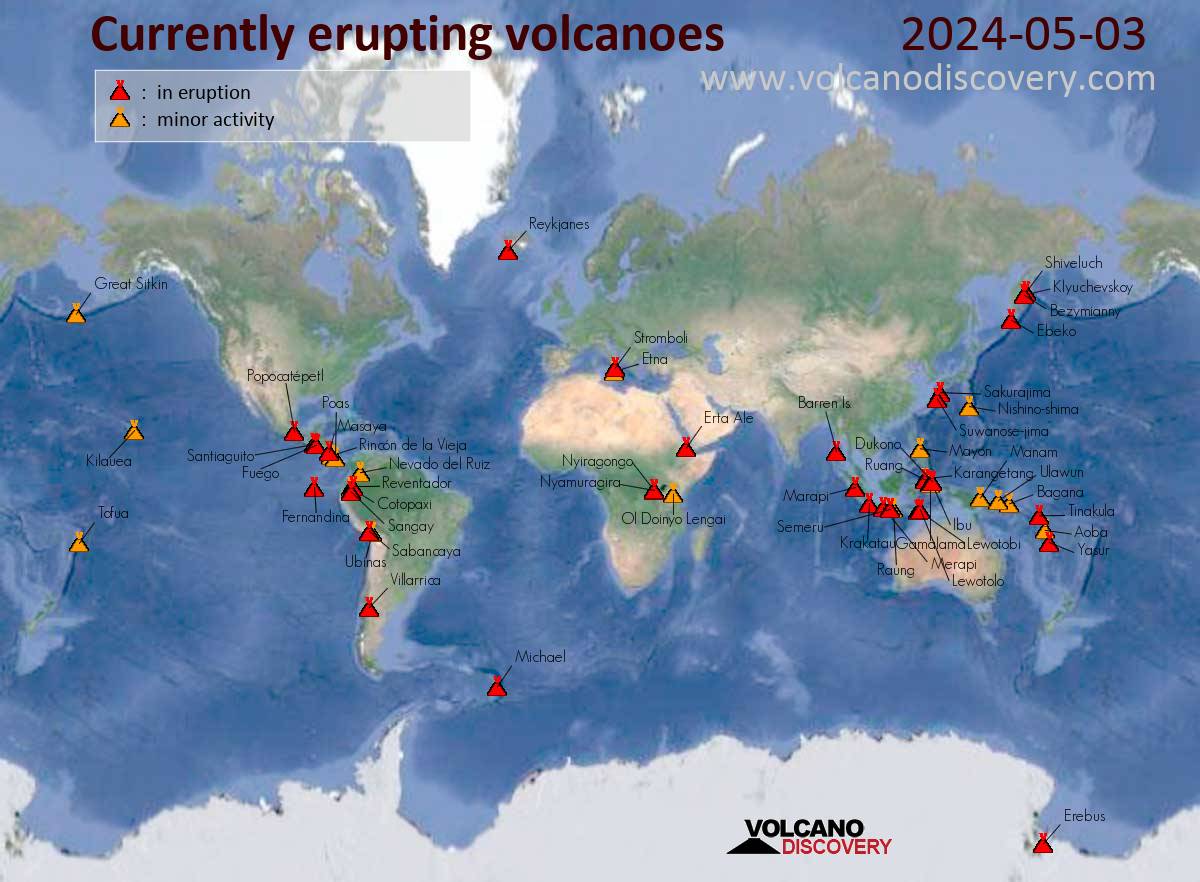
A spectacular burst of volcanic activity around the world just before Christmas! Hawaii's Kilauea volcano, Italy’s Mount Etna, the Sheveluch volcano (Kamchatka, Russia), Sabancaya volcano Peru, Mexico's Popocatepetl volcano and two in Japan all putting on a spectacular show

Popocatepetl Volcano eruption yesterday, credit Webcams de Mexico

A spectacular burst of volcanic activity around the world just before Christmas has enthusiasts excited after a fairly quiet year.

Hawaii's Kilauea volcano has roared back to life, creating a lava lake that has been growing several meters per hour, the US Geological Survey said on Monday. The eruption started after a 4.4 magnitude earthquake struck the volcano's south flank a day earlier. The Halemaumau crater of the volcano is shooting lava, gas and ash into the air. A particularly vigorous eruption occurred within an hour when lava poured into a crater and mixed with the water accumulated inside, Tom Birchard, a senior forecaster with the National Weather Service, Hawaii, told The Associated Press. Birchard added that a steam cloud as high as 30,000 feet (some 9,150 meters) had shot into the atmosphere.

The recent volcanic activity at Italy’s Mount Etna intensified overnight, as a large stream of lava spewed out westward from Europe's largest and most active volcano, putting local residents on edge as 2020 draws to a close. The eruption at the 3,329-meter (10,922-foot) volcano’s southeast crater reignited, resulting in yet another lava-fountaining episode (known as a paroxysm), lighting up the Sicilian skies in the early morning, before filling them with thick clouds of smoke and ash.

The paroxysm was shorter but stronger than the event on December 13 and was accompanied by a sharp peak in a seismic activity which lasted for around two hours. According to some reports, the recent activity could mark the beginning of a new cycle of increased paroxysms at the volcano in the coming days and weeks, not ideal news for beleaguered local residents as the end of 2020 comes so agonizingly close. 

More than 500,000 people live around the base of Mount Etna which has a history of violent eruptions and is one of the most active volcanoes on earth. 

Sheveluch volcano (Kamchatka, Russia): powerful eruption; emissions to 28,000 ft. A spectacular volcanic explosion occurred from the crater at 12:20 local time today as volcanological observatory KVERT reported. The plume of ash rose to an altitude of 16,000 ft (4,876 m) and formed a relatively large umbrella region in the upper part of the eruption column.

A few hours later, at 19:30 local time on today evening, another strong explosion detected by Volcanic Ash Advisory Center (VAAC) Tokyo produced a spectacular ash plume rising up to 28,000 ft (8,500 m) altitude and extended about 130 km to the southeast of the volcano. Incandescence continues to be observed in the crater identified in satellite data. The volcano's lava dome remains in a very active state. Volcano discovery.

Sabancaya volcano Peru has erupted and has spewed ash and gas emissions to 24000 ft (7300 m) Wed, 23 Dec 2020.  Explosive activity continues. Volcanic Ash Advisory Center (VAAC) Buenos Aires warned about a volcanic ash plume that rose up to estimated 24000 ft (7300 m) altitude or flight level 240 and is moving at 10 kts in SW direction.

In Mexico, the Popocatepetl volcano is causing concern after a large eruption spewed a volcanic ash plume that rose up to estimated 19000 ft (5800 m) altitude or flight level 190. Wed, 23 Dec 2020, 09:15 09:15 AM | BY VN Explosive activity continues. Volcanic Ash Advisory Center (VAAC), see image above.

The Sakurajima Volcano in Japan is currently erupting.


Suwanosejima volcano (Ryukyu Islands, Japan) - intense strombolian activity continues

Strombolian explosions become stronger than the average size of explosions at the volcano and more frequent at regular intervals of 2 to 4 per hour during the past few weeks. An explosion generated an ash plume which reached approx. 1,968 ft-3,937 ft (600 m-1,200 m) altitude and drifted SW. Some of the lava bombs were ejected as far as 800 m away from the crater. In addition, the activity is accompanied by a strong glow from the Otake crater that suggesting a rise of the flux of magma within the volcano. The warning bulletin states that ballistic impacts of volcanic bombs and pyroclastic flows could affect an area of about 1 km distance from the main crater. 


Thursday, 4 July 2019

Tourists jump into the sea in panic as Italian volcano erupts: A powerful mag 6.2 quake off the west coast of Canada: Major quake and volcano activity uptick continues

Credit ANSA

A volcano on the island of Stromboli, Italy has erupted, throwing ash high into the sky, with tourists reportedly throwing themselves into the sea in panic.
Italy's ANSA news agency reported that tourists, frightened by the unexpected explosion on the small Mediterranean island, had thrown themselves into the sea.
It said two new lava spouts are creeping down the volcano on the famed island.
The volcano was also shooting out red-hot rocks called lapilli, local sources said.
One eyewitness added: "A huge column of dense black smoke is coming out of the crater."
Another said: "There was a powerful explosion.
We heard a bang, then a column of smoke and lapilli fell onto Ginostra, and flames on the slopes of the volcano".
Fires have broken out across the island, according to fire services and forest rangers.
It's not a particularly active volcano, so that's a surprise." Michela Favorito, who works in a hotel near Fico Grande, on the east side of the island, said: "We saw the explosion from the hotel.
There was a loud roar.
"We plugged our ears and after this, a cloud of ash swept over us.
"The whole sky is full of ash, a fairly large cloud."

Meanwhile, a powerful shallow, magnitude 6.2 rocked the west coast of Canada continuing the increase in major quake activity recently.
Last night's quake was the 79th major quake of 2019, which is 35 more than the same period last year and 32 more than the same period in 2017.

As we move into July the uptick in volcano activity has suddenly spiked.
Alert Level Raised at Hawaii's Mauna Loa Volcano, the World's Largest Active Volcano.
Federal officials raised the alert level Tuesday for the world's largest active volcano, Hawaii's Mauna Loa, which last erupted in 1984.
The U.S. Geological Survey changed the level from "normal" to "advisory" following a steady increase in earthquakes and ground swelling that began in March.
Meanwhile, at least 16 volcanic quakes and six rockfall events on the Mayon Volcano were recorded by the Philippine Institute of Volcanology and Seismology (Phivolcs), signifying a renewed abnormal behaviour since its last eruption in January last year. In its bulletin on Tuesday, Phivolcs said the volcano's seismic monitoring network recorded the quakes and rockfall events in the last 24-hour observation period.
Peruvian scientists are registering a 100 to 120 seismic events per day in the volcano of Ubinas, which is a sign of increasing eruptive activity of the volcano, Hernando Tavera, executive president of Peru's Geophysical Institute (IGP), told Sputnik.
Last week, IGP warned about the intensified eruptive activity of the Ubinas volcano and issued a recommendation for local authorities to raise the alert level over a possible eruption. "Currently we are registering from 100 to 120 seismic events in Ubinas, while earlier we recorded one [seismic event] per day ...
At the same time we should take into account that Ubinas is a very active volcano," Tavera said.
He added that Ubinas was the most active volcano in Peru.
Mount Merapi, which located at the border area of Yogyakarta Special Region and Central Java, spewed a lava avalanche on Sunday up to 850 meters in distance, according to the Geological Disaster Technology Research and Development Center (BPPTKG).
Lava avalanche monitored by surveillance cameras during the observation period from 12:00 to 6:00 a.m Western Indonesian Time (WIB) was flowing upstream of Gendol River, the Head of BPPTKG Hanik Humaida stated. During the observation time, there were also two volcanic earthquakes monitored with amplitude ranging between 4 to 27 millimetres and lasting between 41.8 to 85 seconds.
Meanwhile July's first major quake, a mag 6.0 struck Vanuatu yesterday close to one of the most active volcano area in the world.

June saw a large uptick in volcano activity accompanied by a spike of major quakes around the Pacific Ring Of Fire.
A total of 18 major quakes with all of them recorded around the Pacific Ring Of Fire were registered in June, the largest number of major quakes recorded in one month this year.
A total of 78 major quakes have been recorded this year so far.

Volcanoes

Front Page
 

Monday, 8 July 2019

July's incredible uptick in volcano activity continues: The Mexican colossus, Popocatépetl Volcano spews ash plume 24,000 ft (7,300 m) into the Mexico sky.

Image Cenepred

The Mexican colossus, the Popocatépetl Volcano, whose name is the Aztec word for smoking mountain and towers to 5426 m 70 km SE of Mexico City to form North America's 2nd-highest volcano is currently spewing a volcanic ash plume that rose up to an estimated 24,000 ft (7,300 m) into the Mexico sky.

July has seen an incredible uptick in volcano activity.

An earthquake swarm started on the evening of July 5 at the southern margin of Coso Volcanic Field in Inyo County, California.
The swarm activity was triggered by a magnitude M5.4 earthquake at 9:19 PM PDT located 20 km (~20 miles) ESE of Little Lake, which itself was likely an aftershock of the M7.1 earthquake that occurred about an hour earlier 17 km NNE of Ridgecrest, and south of the Coso area.
An average of about 30 earthquakes per hour has been detected since, most within the range of magnitude M1 to M3.
The California Volcano Observatory will continue to monitor the situation for any sign of volcanic activity and provide updates as warranted.

The Alert Level was raised at Hawaii's Mauna Loa Volcano, the World's Largest Active Volcano, last Tuesday.
Federal officials raised the alert level last Tuesday for the world's largest active volcano, Hawaii's Mauna Loa, which last erupted in 1984.

Meanwhile, at least 16 volcanic quakes and six rockfall events on the Mayon Volcano were recorded by the Philippine Institute of Volcanology and Seismology (Phivolcs), signifying a renewed abnormal behaviour since its last eruption in January last year. In its bulletin last Tuesday, Phivolcs said the volcano's seismic monitoring network recorded the quakes and rockfall events in the last 24-hour observation period.

Peruvian scientists are registering a 100 to 120 seismic events per day in the volcano of Ubinas, which is a sign of increasing eruptive activity of the volcano, Hernando Tavera, executive president of Peru's Geophysical Institute (IGP), told Sputnik.
Last week, IGP warned about the intensified eruptive activity of the Ubinas volcano and issued a recommendation for local authorities to raise the alert level over a possible eruption. "Currently we are registering from 100 to 120 seismic events in Ubinas, while earlier we recorded one [seismic event] per day ...
At the same time we should take into account that Ubinas is a very active volcano," Tavera said.
He added that Ubinas was the most active volcano in Peru.

Mount Merapi, which located at the border area of Yogyakarta Special Region and Central Java, spewed a lava avalanche last Sunday up to 850 meters in distance, according to the Geological Disaster Technology Research and Development Center (BPPTKG).
Lava avalanche monitored by surveillance cameras during the observation period from 12:00 to 6:00 a.m Western Indonesian Time (WIB) was flowing upstream of Gendol River, the Head of BPPTKG Hanik Humaida stated. During the observation time, there were also two volcanic earthquakes monitored with amplitude ranging between 4 to 27 millimetres and lasting between 41.8 to 85 seconds.

On Friday, a volcano on the island of Stromboli, Italy erupted, throwing ash high into the sky, with tourists reportedly throwing themselves into the sea in panic.
Italy's ANSA news agency reported that tourists, frightened by the unexpected explosion on the small Mediterranean island, had thrown themselves into the sea.

June saw a large uptick in volcano activity accompanied by a spike of major quakes around the Pacific Ring Of Fire.
A total of 18 major quakes with all of them recorded around the Pacific Ring Of Fire were registered in June, the largest number of major quakes recorded in one month this year.
A total of 82 major quakes have been recorded this year so far as the uptick continues.

Live video showing Popocatépetl Volcano eruption 

xx

Volcanoes

Front Page
 

Tuesday, 30 August 2016

Mexico's Colima or "Fire" Volcano spewes a large column of gas and ash 2.5km into the sky


Photo www.volcanodiscovery.com
Mexico's Colima or "Fire" Volcano spewed a large column of gas and ash some 2,400m high into a blue sky on Monday (Aug 29).
According to officials, the latest eruption took place on Monday at 12.19pm Mexican time.
The Fire Volcano, officially known as the Colima Volcano, is part of the Pacific Ring of Fire.
Mexico contains over 3,000 volcanoes, but only 14 are considered active.
Major eruptions in Mexican history have included the 1953 eruption of the Paricutin Volcano in Michoacan, the 1982 eruption of Tacana Volcano in Chiapas and the 1986 eruption of the Colima Volcano.

Home page

Related


Thursday, 11 March 2021

Impressive and not to be outdone by this year's record-breaking major quake toll! Volcano activity is just as impressive. Mount Etna dumps a year's waste (ash) in 45 minutes: Mnt Sinabung, Indonesia, San Cristobal Nicaragua, Guatemalan Pacaya volcano all blowing: 49 volcanoes around the world erupting or showing signs of activity!

Indonesian colossus Mount Sinabung:  Credit Wikipedia. (File)

A new eruption of the Sinabung volcano in Indonesia:

The volcano on the island of Sumatra projected smoke and ash up to 1,000 meters high, which travelled up to 3 km to the southeast, according to the Indonesian Volcanology and Geological Hazard Mitigation Center. Villagers were advised to stay at least 3km away from the crater. The alert is maintained at the second-highest level as authorities are closely monitoring the volcano after sensors have detected increased activity in recent weeks. The 2,600-meter mountain has been showing intense activity since last year. In recent years, around 30,000 people have been forced to leave their homes in the area around Sinabung. Sinabung is among more than 120 active volcanoes in Indonesia, the country is subject to earthquake shocks due to its location on the Pacific "Belt of Fire", an arc of volcanoes and fault lines that surround the Pacific Basin.

Nicaragua. The violent eruption of the San Cristobal volcano

The town of Chinandega, Nicaragua, was under a cloud of ash Tuesday afternoon after the eruption of the San Cristobal volcano. The San Cristobal volcano, in northwest Nicaragua, erupted on Tuesday with violent explosions projecting ash and toxic gases that reached the city of Chinandega, in the northwest of the country. The volcano, which peaks at 1,745 mothers, was rocked by a sudden explosion, raising a column of ash and smoke blown by the wind towards Chinandega, located about 17 km away, testified Carol Altamirano, a journalist who lives in the city. The town of Grecia and surrounding villages have also been affected, according to the NGO Humboldt Environmental Center. The volcano was rocked by four explosions on Tuesday starting at 1:25 p.m. local (19:25 GMT), according to the Humboldt Center. Ouest France

Effusive activity at the Guatemalan Pacaya volcano increasing.

Credit Volcano Time-Lapse

Guatemala - Increased effusive activity and strong lava emission at Pacaya volcano, Guatemala

Accompanied by strong lava emission and lava flows approximately 1.3 km (0.8 miles) in length. Authorities warned there is an increased probability of new lava flows generated on other flanks. The volcano exhibited incremental eruptive pulses with constant moderate to strong explosions since February 5, 2021, expelling ballistic and volcanic material 500 to 600 m (1 640 - 2 000 feet) above the Mackenney crater. The ash has spread to the SW, S, and SE up to 30 km (19 miles) from the volcano, with fine ash reported in the communities of Pacaya, Finca El Chupadero, Finca La Laguna, and others in the sector. The Pacaya National Park is still closed and access to the areas of active lava flows on the southern flank of the volcano is prohibited.

European Colossus Mount Etna dumps a year's waste in 45 minutes.

Mount Etna, credit Volcano Time-Lapse

A fall of ash of this magnitude many do not even remember. A few days after the eruption of Etna on Sunday morning, the foothills have to deal with the extraordinary cleaning of streets and roofs. Among the areas most affected by the emergency is Giarre with its nearly 28,000 residents. "There are six kilograms of ash for every square meter - explains the mayor Angelo D'Anna to fattoquotidiano.it - ​​According to our calculations, in about 45 minutes a quantity of material comparable to the waste collection we do in a year has fallen ". To clean the main roads, the administration had to resort to extremely urgent tasks, relying on various private companies that provide men and vehicles, in particular sweepers and trucks. The ash ends up in collection areas from where it must then be disposed of as special waste. For the moment, the schools remain closed waiting for the cleaning work to be completed: "I have about 8000 pupils who are at home - complains the mayor - But if the minimum safety conditions are not created, I cannot allow the activities to resume. didactic ".

On Sunday there was also an inspection by the regional civil protection and by the regional president Nello Musumeci who declared a state of crisis and asked Rome for an emergency. However, the mayors have not yet received any financial aid and have been forced to commit municipal funds in the budget despite the fact that the eruption began in mid-February and was often accompanied by falling ash. Ill Fatto

Impressive and not to be outdone by this year's record-breaking major quake toll! Volcano eruptions and activity has been just as impressive.

xx

Wednesday, 3 August 2016

Vocano Uptick: The Nevados de Chillán volcano erupt's a dense plume of ash 3600 m into the sky


Photo lechaudrondevulcain.com
Scroll down for incredible video.
A busy week for volcano activity as The Nevados de Chillán volcano is the latest to show activity.
The activity at the volcano has again increased.
While degassing and weak, sporadic ash emissions have become more frequent again since mid July, a more intense phase of activity took place yesterday: starting around 17:10 local time, the volcano erupted a dense plume of ash from the crater that rose several hundreds of meters to 3500-3600 m altitude and quickly dispersed.
Ash fall occurred near the summit.
The activity lasted a few minutes, but was the strongest since the volcano's activity in May this year, reports Volcano Discovery.
The Nevados de Chillán volcano in the Bío Bío Region of Chile has been on and off degassing in 2016.
Activity has increased there recently and yesterday the volcano began erupting ash, smoke and gases. Skier Jess McMillan was on the mountain taking some runs and caught the activity on video. McMillan is in Chile with Powder Quest, a company that runs snowboard and ski adventures in South America and Japan.
Others are also at the resort, Nevados de Chillán, and have also documented the fumarolic emissions. The website Volcano Discovery has a good log of the volcano's activity, and says that scientists had detected increased levels of sulfur oxide and earthquakes, and predicted that increased activity may be coming.
Unsure if magma is present, it seems to be a situation not of immediate danger.

xx

Home page

Related


Friday, 5 January 2018

Off we go! The highest active volcano in Eurasia is the first volcano activity report of 2018 as The Klyuchevskoy Volcano spews ash 5.5 km high!

A gas-steam activity of Klyuchevskoy volcano on 03 December 2017/ Credit Kamchatka Volcanic Eruption Response Team (KVERT)

It's exciting, it's an old friend and it's the highest active volcano in Eurasia, the first volcano activity report of 2018...Off we go!
The Klyuchevskoy Volcano in the Kamchatka Region has been spewing up ash for three days in a row, the Kamchatka Volcanic Eruption Response Team (KVERT) at the Institute of Volcanology and Seismology of the Far Eastern Department of the Russian Academy of Sciences told TASS on Friday. "The volcano emitted ash as high as 5.5 km [above sea level.] The volcano itself is 4.75 km high," the response team specified.
The ash spread 92 km in a north-western direction from the volcano.
This is the third time Klyuchevskoy erupted ash in 2018.
On January 3, it spewed up ash as high as 6 km, and on January 4 an orange hazard code was declared for aircraft after the second eruption at the same height.
Klyuchevskoy is Eurasia's highest active volcano, reaching 4,750 meters high, and one of the most active on the peninsula.
In 2016, up to 10 lava flows oozed down its slope simultaneously during an eruption.
The nearest community - the village of Klyuchi in the Kamchatka Region- is located 30 km away from the volcano base.
Ash falls are frequently observed there during eruptions.

The last big eruption was reported on the morning of May 18, 2017, according to the image data of the Kamchatka Volcanic Eruption Response Team (KVERT), a column of ash was registered above the Klyuchevskoy volcano was said to have reached 6,000 meters.
The volcano is 4,750 meters high," the press service said.
The aviation colour code was then raised to orange.
The ash covered the areas located 72 kilometres north-east of the volcano.
There are no settlements in the area.

The Klyuchevskoy (Klyuchevskaya Sopka) is the highest active volcano in Eurasia.
The volcano is approximately 7,000 years old.
There are currently four active volcanoes on the territory of the Russian Far Eastern Kamchatka region - Klyuchevskoy, Shiveluch, Bezymyanny, and Karymsky.

Home


Wednesday, 22 June 2016

Icelandic volcano Hekla - dubbed "The Gateway to Hell"- Experts say it could blow any minute: Could cause volcanic winter


PHOTO volcano.oregonstate.edu

  • We could be looking at a major disaster when the next eruption begins
  • Powerful explosion in the volcano would put many lives at risk
  • Hekla is showing pressure readings higher than they were during the eruptions in 1991 and 2000
Experts have warned people to stay away from the Icelandic volcano Hekla - dubbed the "Gateway to Hell" - as the volcano could blow "at any minute".
Experts say pressure is building up within the volcano, and an explosion could occur anytime, without warning.
Iceland is located on a divergent tectonic plate boundary on the mid-Atlantic Ridge.
There are 30 active volcanic systems (out of 130) in the country.
Hekla volcano is a stratovolcano located in South Iceland.
It is 1,491 meters high and is also a popular tourist destination.
The volcano has erupted regularly in the past - approximately once every 10 years between 1970 and 2000.
Scientists believe Hekla have erupted about 20 times since 874 AD.
During the Middle Ages, it was nicknamed "Gateway to Hell" by Europeans.
However, the volcano has been quiet for the past 16 years, leading scientist to believe that it is building up for a major outburst.
Hekla is a stratovolcano in the south of Iceland with a height of 1,491 meters (4,892 ft).
"Hekla is a dangerous volcano," University of Iceland Geophysics Professor Páll Einarsson told Icelandic news agency Visir.
According to Professor Einarsson, who has studied the peak in much detail, "Hekla is ready at any moment."
"We could be looking at a major disaster when the next eruption begins if we are not careful." Professor Einarsson says a powerful explosion in the volcano would put many lives at risk.
There would be travel disruptions also because many planes fly directly over Hekla daily.
A powerful eruption is also likely to impact flights to/from the UK.
"There are also 20-30 planes full of passengers flying right over the top of Hekla every day," Professor Einarsson said.
"This is a risky moment which we need to take seriously."
Einarsson reveals that Hekla is showing pressure readings which are higher than they were during the eruptions in 1991 and 2000.
In its last eruption, Hekla caused a pyroclastic flow, thereby producing a wall of gas and rock that reached 450 mph.
Just 30 miles away from Hekla is located another active volcano - Eyjafjallajökull - which most recently erupted in 2010.
The massive plume of volcanic ash produced after the blow went into the atmosphere, resulting in grounding of air traffic over Europe and a knock-on effect on international flights.
The shut down of airspace from April 14 to 25 that year had left millions stranded around the world

Home Page

Related

Kanlaon Volcano in Negros Philippines erupts ash 1,500 meters above the crater

Bulusan volcano, Philippines eruption 2km high

A magnitude 6.2 - 98km NNW of Isangel and seismic activity from the Suretamatai volcano Vanuatu

After 60 years of inactivity: The Bristol Island volcano, spews ash gas and steam into the South Georgia sky after heavy quake activity

Russia's Klyuchevskaya Sopka Eurasia's largest volcano spews ash 6 kilometers into the sky

Sunday, 24 September 2017

September devastation! After Hurricanes, Cyclones, Floods, Massive Quakes and X-class flares: Volcanoes around the world are starting to rumble!

A curious villager looks on near the summit of Mount Agung, an active volcano which is showing increased seismic activity, on the resort island of Bali, Indonesia Antara Foto/Nyoman Budhiana/via REUTERS

September 2017 will turn out to be the most catastrophic month in recent history with 4 category 5 hurricanes in the Atlantic, two tropical cyclones hitting China and Japan, devasting floods in India and Bangladesh with all the above resulting in more than 50 million people being evacuated.
Add to that a mag 8.1, the biggest earthquake this year and a devastating mag 7.1 both in Mexico.
We also had 4 massive X-class flares, the biggest, an X9.3 being one of the biggest ever recorded.
Well, now the volcanoes are getting in on the act, all around the world reports of tremors, volcano activity, ash and steam clouds escaping as they become restless.

This week, Mount Agung on Indonesia's Bali island was ramped up to its highest alert level, with thousands evacuated leading Bali's Governor to claim: "This is a natural disaster, we cannot avoid, we can't stop it exploding"
The last time this volcano erupted was in 1963 killing more than a 1,000 people and injuring thousands more.

The volcanic alert level for Manaro Voui volcano on Ambae island was raised to the second highest (4: "moderate eruption") on Vanuatu's scale of 1-5 this Saturday, as the activity intensified gradually over the past weeks.
A vent in or near the caldera lake Voui has been producing mild ash emissions over the past weeks, but these have now become stronger and for the first time lava glow also was observed, suggesting that the eruption is transitioning from phreatic (steam-driven) to magmatic (arrival of fresh magma).
According to local press articles, authorities in Vanuatu are preparing to evacuate up to 5000 people from the island's most exposed areas to safer locations.

After a month of sorrow, yesterday, Mexico's colossus Popocatepetl volcano erupted ash and gas into the sky after three major quakes and massive devastation has hit the area this month.
According to the National Seismological Centre in Mexico, there were three tremors, measuring on the Richter Scale 6.1 at 7.52 am, 5.2 at 8.24 am and 5 at 8:25 am.
The volcano is at level 2 alert, meaning it could continue erupting ash and gas.

The 14,000-foot snowcapped volcano Mount Rainier was this week the latest American "Super Volcano" showing unrest after tremors hit the active volcano.
Some two dozen minor tremors have hit Mount Rainier, the active volcano towering over the Seattle metro area, over the past week.
The strongest of the quakes had a magnitude of 1.6, according to the Pacific Northwest Seismic Network (PNSN) run by the University of Washington and the University of Oregon.
Also this month The U.S. Geological Survey says a strong magnitude 5.3 earthquake rumbled through southeast Idaho, just 60 miles south of Yellowstone National Park.
The USGS reported four separate quakes in an area about 63 miles from Pocatello and 130 miles from Salt Lake City.
The largest quake at magnitude 5.3 struck just before 6 p.m. local time.
The USGS said a handful of smaller quakes followed for about an hour.
An ongoing earthquake swarm at Yellowstone volcano is now one of the biggest ever recorded, with over 2,300 tremors since it began in June.
As of August 30, 2,357 earthquakes had been recorded.
The most powerful in recent weeks was magnitude 3.3; it took place on August 21.
The most powerful in the current swarm was a magnitude 4.4, which was recorded on June 15.
Yesterday's mag 5.3 is by far the biggest.

A Volcano Eruption on Fernandina Island in the Galapagos of Ecuador.
It was confirmed as a new eruptive phase of Fernandina's La Cumbre volcano.
After eight years of relative calm, this volcano began generating a column of water vapour and magmatic gases that were about four kilometres high.

Earlier this month The Vanuatu Meteorology and Geohazards Department is warning tourists and aviation centres of increased volcanic activity throughout the island group.
Meteorologist Esline Bule says tourists must stay at least at least three kilometres away from volcanic craters and the Volcanic Ash Advisory Centre in Wellington is being kept updated in case flights need to be diverted around ash plumes.
She says volcanic ash has already affected some villages on Ambae but the Disaster Management Office has not ordered any evacuations. She told Jenny Meyer the islands of Ambrym and Ambae are currently the most active but Lopevi is also now starting to awaken.
In Vanuatu, at the moment we are closely monitoring Ambae volcano,  Ambrym volcano and Manaro Voui volcano.

Home


Friday, 23 September 2016

Mount Bulusan in the Philippines seen "bulging at the volcano's edifice" along with seismic activity and signs of magma building up


Photo www.rappler.com
At least eight volcanic earthquakes were recorded on Mount Bulusan in Sorsogon province in a 24-hour monitoring period from Wednesday to Thursday, the Philippine Institute of Volcanology and Seismology (Phivolcs) said on Thursday.
Phivolcs, in a bulletin issued at 8 a.m., said Alert Level 1 remained hoisted over Bulusan to warn people of an abnormal activity.
Ed Laguerta, Phivolcs' resident volcanologist here, said the earthquakes were possibly due to hydrothermal pressure.
Laguerta said seismic instruments that recorded the quakes on Bulusan posted "no intensity," meaning these were triggered by steam-driven pressure that led to fracturing of cap rocks beneath the volcano's vent.
He allayed fears that the quakes could pose danger, saying "the [earthquakes'] magnitude was minuscule that it could not be [plotted] and was insignificant to cause an alarm."
"What we are closely monitoring is the presence of low frequency harmonic tremors (continued rhythmic earthquakes) because these are signs that magma is building up," Laguerta said.
Phivolcs asked residents along the volcano's slope, including visitors, to avoid venturing into the 4-kilometer permanent danger zone (PDZ) due to the possibility of sudden steam-driven (phreatic) eruptions.
A Phivolcs bulletin said volcanologists observed a "weak emission" of white steam plumes that drifted west-northwest.
The agency said bulging at the volcano's edifice was observed, indicating that the volcano remains restive.
Residents along rivers and streams near the volcano's slopes were also alerted against rock and lahar flows in times of heavy rain.
Pilots were also warned to avoid flying close to the volcano's summit as ash from any sudden phreatic eruption "can be hazardous to aircraft."
In Albay, Phivolcs said Mount Mayon remained calm in the past 24 hours, although the volcano continued to spew a slightly bluish plume.
Volcanologists said no crater glow was observed on Mayon.
However, Alert Level 1 is still hoisted over Mayon, indicating its abnormal activity.
Phivolcs said people should avoid entering the 6-km permanent danger zone around Mayon due to sudden ash puffs and steam-driven eruptions.

Home page

Related


Tuesday, 30 August 2016

Huge Katla volcano in southern Iceland hit by 2 quakes Monday has seismologists worried: Could cause catastrophy for the Northern Hemisphere


Photo www.wired.com
  • The Laki eruptions of 1783 in Iceland killed around 23,000 people in the UK.
  • A new eruption could cancel out summer in the northern hemisphere killing people, livestock and crops
  • Katla, which is named after an evil troll, is one of the largest of its kind on the volcano-dotted island and last erupted in 1918.
  • People have been expecting an eruption for 50 years

Seismologists say a huge volcano in southern Iceland, which is overdue an eruption, has been shaken by two large earthquakes.
The tremors, measuring 4.5 and 4.6 in magnitude, were recorded at the Katla volcano early in the morning of Monday (29 August).
Katla, which is named after an evil troll, is one of the largest of its kind on the volcano-dotted island and last erupted in 1918.
It usually erupts roughly every 80 years and although it is overdue, an earthquake at Katla took place in 2011 but no eruption was recorded.
However, scientists say just because there are tremors an eruption will not necessarily follow. Geophysicist Gunnar Gudmundsson told Mail Online that seismic activity at Katla was "a little bit unusual" but that there was currently no indication of an eruption.
"People have been waiting for an eruption for 50 years," said Gudmundsson.
Icelandic Met Office (IMO) Natural hazards scientist Matthew Roberts told reporters: "It is quite a dynamic situation now, in the next hours and days following this, but as we speak at the moment we do not see any signs that there is an imminent hazardous unrest about to happen."
Iceland sits on one of the world's most active regions of volcanic activity.
In 2014 the massive Bardarbunga volcano erupted, generating the same thermal energy as at Hiroshima every two seconds for six months.
Two cubic kilometres of material were ejected, making it the biggest volcanic eruption in Europe for 240 years.
In 2010, the eruption of Eyjafjallajokull sent huge clouds of volcanic ash into the atmosphere, causing a danger to planes.
Much of Europe's air network was shut down for six days, causing chaos worldwide.
Scientists fear if one of Iceland's "super-volcanoes" erupted it could cause devastation here - the Laki eruptions of 1783 in Iceland killed around 23,000 people in the UK.

Home page

Related